Period Pain Relief | Menstrual Pain Treatment | Dysmenorrhea Treatment
Table Of Content
- Moving Beyond 'Period Pain Sabko Hota Hai'
- Is it regular period pain? Is It a Red Flag? Use Our Period Pain Calculator
- How to Manage Period Pain: Dysmenorrhea Treatment
- For Ishani, Riddhi & Tarini: A Diagnosis and a Path to Hope
- Treating Secondary Dysmenorrhea
- Why Diagnosis of Period Pain is Everything
- Breaking the Cycle of Silence: Talking to Your Mother or Grandmother About Period Pain
- Taking Action: The First Step to Relief
- The Answers You've Been Looking For
- References
Moving Beyond 'Period Pain Sabko Hota Hai'
Now that you have the vocabulary to describe your pain and the knowledge to understand its causes, the next crucial step is to explore the treatments and solutions available to you. For Priya, Ishani, Riddhi, and Tarini, this journey from silent suffering to proactive care was a transformative one. Their stories show that period pain relief isn’t just a possibility—it’s a right.
The first step on this path is self-observation. Your body is constantly sending signals, and learning to listen to them is the most powerful tool you have. By paying close attention to your pain and any other red flags, you can start to decode your body’s unique story.
Is it regular period pain? Is It a Red Flag? Use Our Period Pain Calculator
Even before you see a doctor, understanding the severity of your period pain can make all the difference. Our Period Pain Calculator is designed to help you do just that. It helps you determine your period pain score—whether it’s normal, moderate, or severe—and identifies any potential red flags that may be present alongside your pain. This tool gives you the data you need to have a clear and confident conversation with your mother, friend or your gyneacologist.
Is Your Period Pain Normal, Moderate or Severe?
Stop guessing, start knowing. Our Period Pain Calculator helps you determine the severity and understand the red flags you need to know for a confident conversation.

How to Manage Period Pain: Dysmenorrhea Treatment
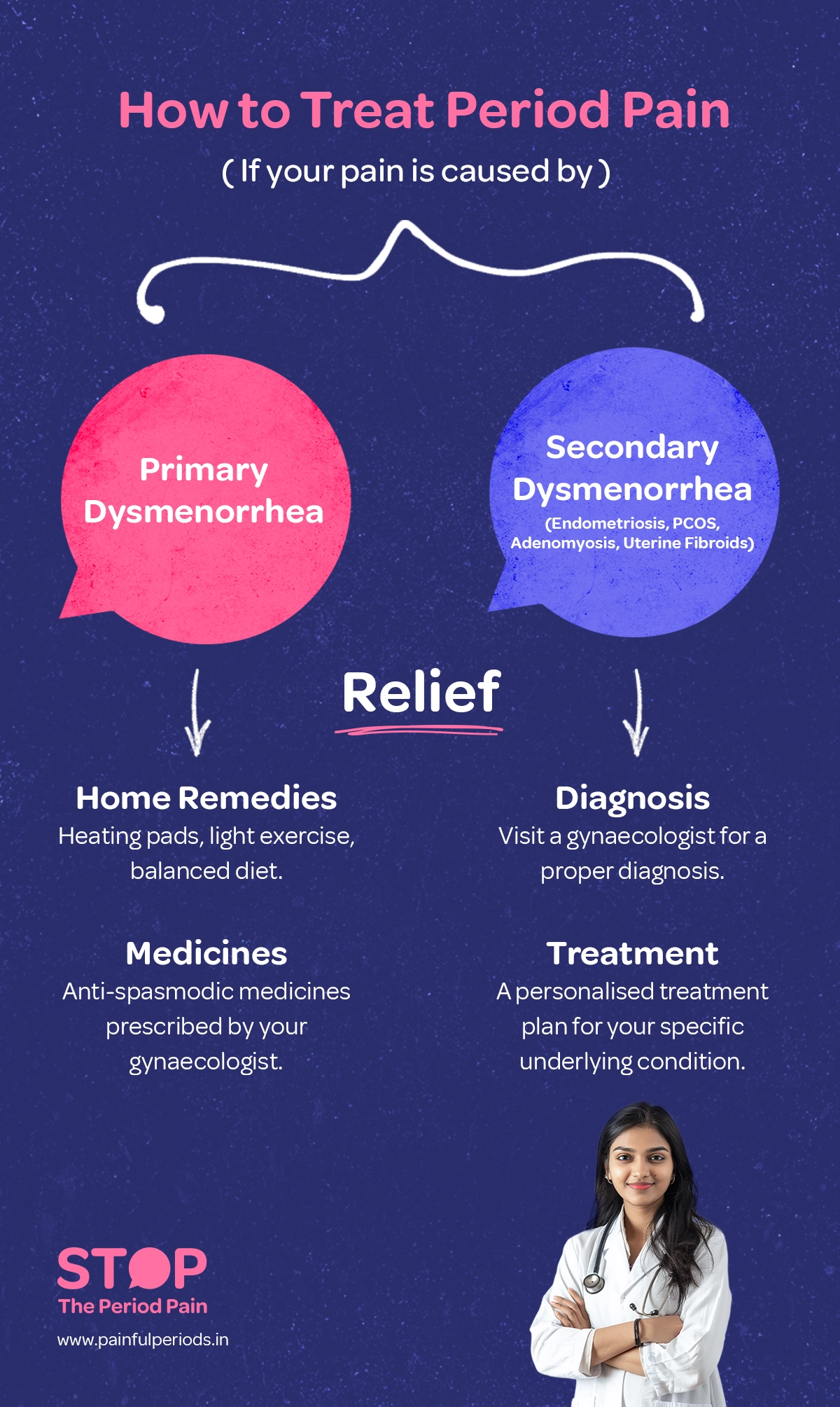
The path to relief is not one-size-fits-all. The right menstrual pain treatment for you depends on whether your pain is a story of Primary Dysmenorrhea or Secondary Dysmenorrhea. While the approach for each is different, the goal is the same: to manage your period pain effectively and improve your quality of life.
For Priya & Primary Dysmenorrhea: Simple Steps, Big Relief
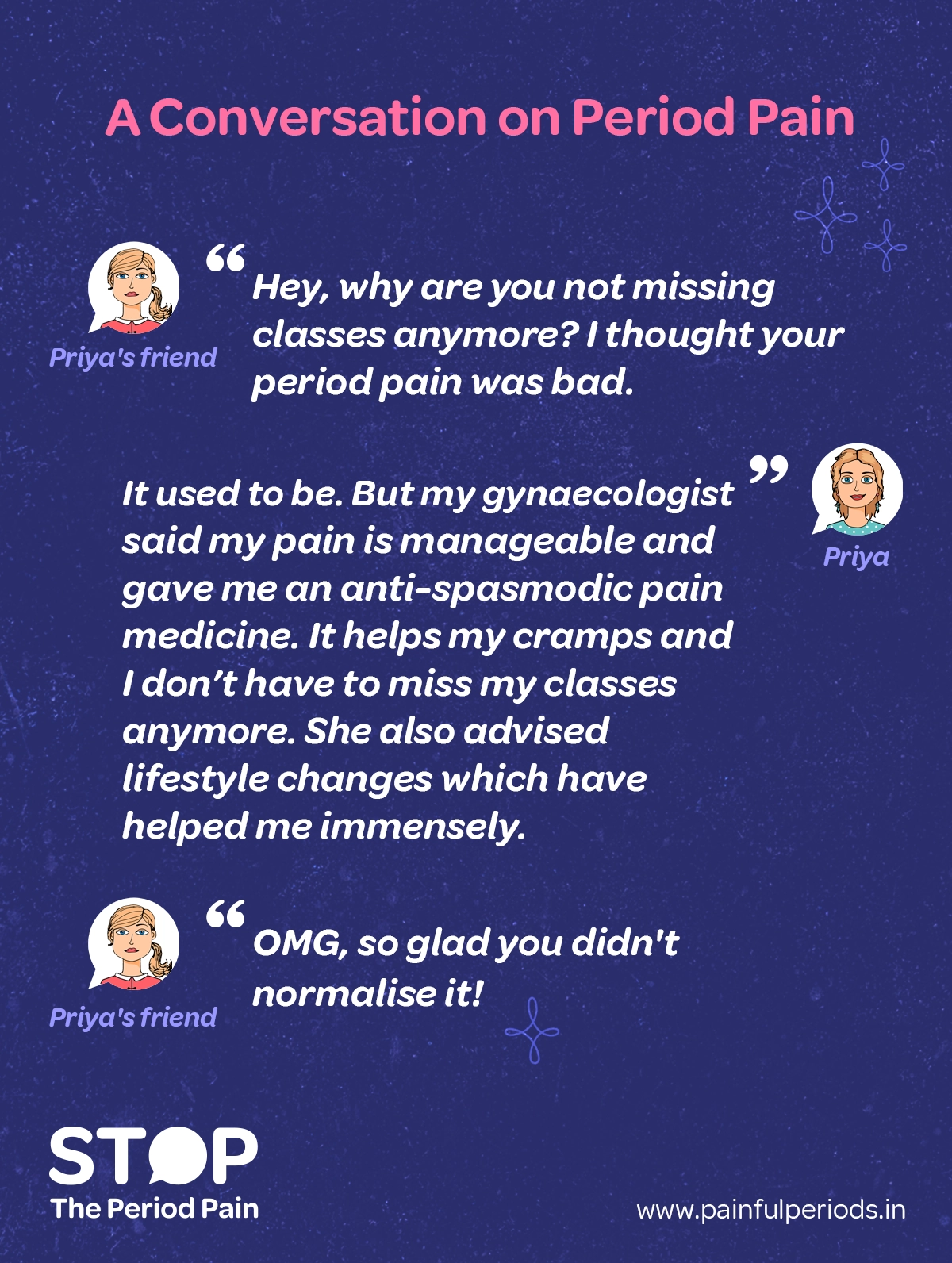
Priya’s journey to a pain-free life started with a simple but powerful realization: her pain, though common, was not something she had to endure. Since her pain was a classic case of Primary Dysmenorrhea—caused by an excess of prostaglandins—the path to relief focused on reducing those uterine contractions.
Her doctor recommended a two-pronged approach for how to manage period pain:
Lifestyle Changes
Simple shifts in her daily routine made a world of difference. She started incorporating regular, light exercise like walking and yoga into her week. A balanced diet rich in iron and calcium helped, and she made it a point to stay hydrated. Applying a heating pad or a warm water bottle to her lower abdomen also provided immediate comfort and helped relax her muscles.
Anti-Spasmodic Medication
To address the pain directly, her gynaecologist prescribed anti-spasmodic medicine. These medicines are specifically designed to relax the muscles of the uterus, directly combating the contractions caused by prostaglandins that help shed the uterine lining. For Priya, taking this medicine at the first sign of a cramp was a game-changer, preventing the pain from escalating and allowing her to go to class and live her life as normal.
For Ishani, Riddhi & Tarini: A Diagnosis and a Path to Hope
For Ishani, Riddhi, and Tarini, the journey to relief was more complex, but no less empowering. Since their pain was a sign of Secondary Dysmenorrhea, the first step was a proper diagnosis. Their doctors conducted a thorough examination and a series of tests, including ultrasounds, to identify the root cause of their menstrual pain.
Once they had their answers—Ishani with endometriosis, Riddhi with adenomyosis, and Tarini with PCOS—their path to relief became clear. They realized their pain wasn’t a fault of their own, but a symptom of a real medical condition that could be treated.
Treating Secondary Dysmenorrhea
Treatment for Secondary Dysmenorrhea depends entirely on the underlying condition. The goal is to address the root cause, which in turn provides menstrual pain treatment.
For Ishani (Suffering from Endometriosis):
Her treatment plan might include a combination of hormonal therapy to manage the growth of endometrial tissue and pain management strategies. In some cases, a gynaecologist might recommend minimally invasive surgery to remove the tissue. To learn more about this condition, explore our detailed guide on Endometriosis.
For Riddhi (Suffering from Adenomyosis):
Riddhi’s gynaecologist focused on period pain relief and managing the heavy bleeding. This might have included hormonal treatments to control her menstrual cycle and reduce the intense cramping. Find more information on this condition by visiting our detailed guide on Adenomyosis.
For Tarini (Suffering from PCOS):
Tarini’s treatment plan centered on managing her hormonal balance through a combination of medication and lifestyle adjustments, which helped regulate her cycles and lessen her pain. You can read our full guide on PCOS to understand it better.
For Diya (Suffering from Uterine Fibroids):
Uterine Fibroids are another common cause of secondary dysmenorrhea, affecting many women with pain and heavy bleeding. You can learn more about this condition and its treatments on our full guide on Uterine Fibroids.
Why Diagnosis of Period Pain is Everything
The stories of these girls highlight a crucial point: you can’t treat what you don’t know. Trying to manage severe, unexplained period pain with a heating pad is like ignoring a pressure cooker’s whistle. While it might seem like a small sound you can ignore, the underlying pressure is still there and could cause a bigger problem.
A proper diagnosis is not an end but a beginning. It gives you the power to find the right path to a pain-free life. For videos on how to manage period pain, please explore our Find Relief page.
Breaking the Cycle of Silence: Talking to Your Mother or Grandmother About Period Pain
For many of us in India, the first person we turn to for advice on periods is our mother or grandmother. While their advice often comes from a place of love, it is also rooted in a generational conditioning that period pain is just a part of life. Phrases like “Sabko hota hai” are not meant to dismiss your pain but to normalize it, a practice that has been passed down through generations.
So, how do you have this conversation without causing offense?
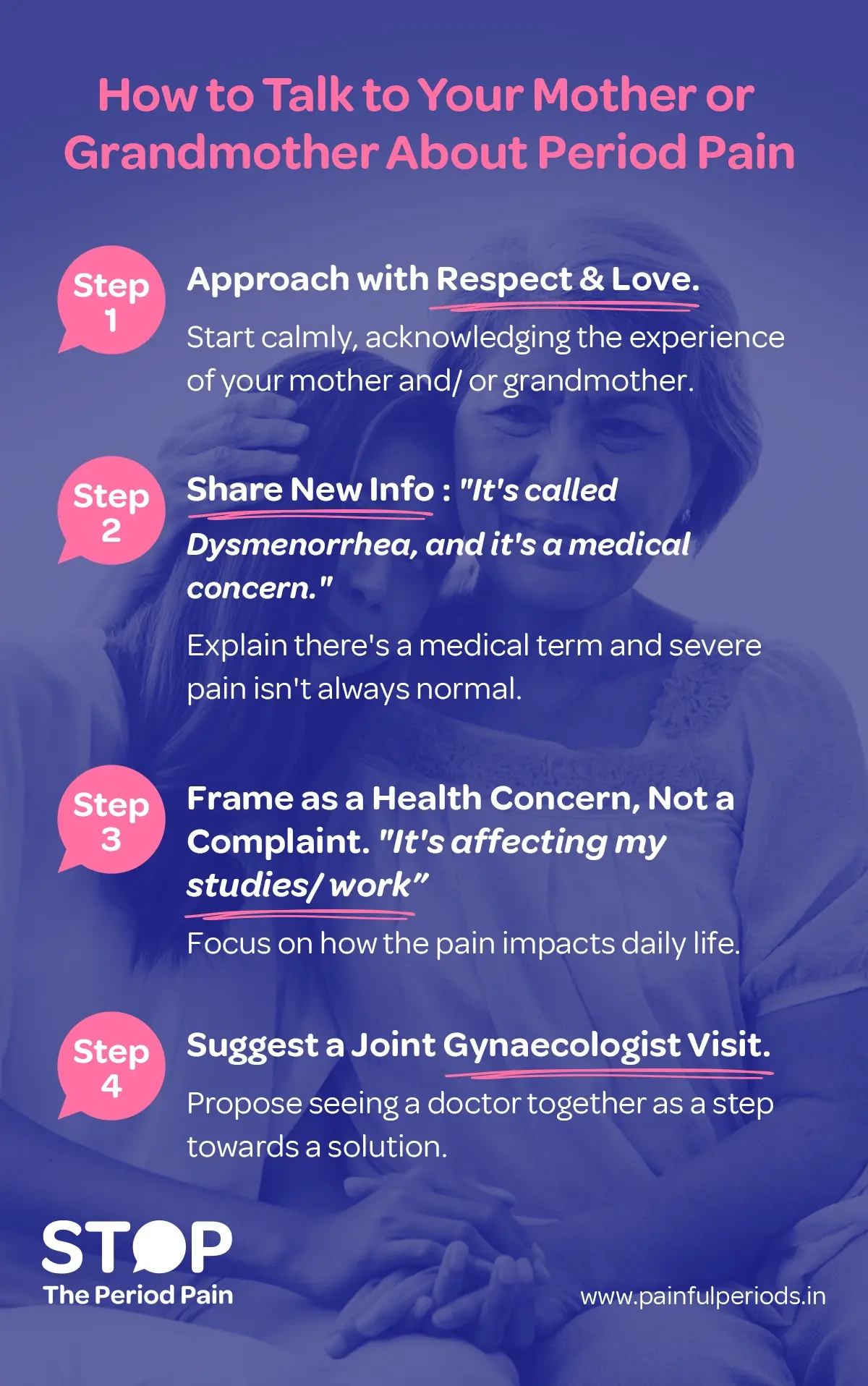
- Approach with Respect: Start the conversation calmly and with love. Acknowledge that you appreciate their guidance and understand that their advice is based on their own experiences.
- Share the New Information: Once you have a moment to talk, share the knowledge you’ve gained. You can explain that you’ve learned that period pain has a medical name—Dysmenorrhea—and that doctors now know it’s not normal when it’s severe. You can say something like, “Mummy, I was reading online and learned that there’s a medical name for the kind of pain I have. It’s called Dysmenorrhea, and it can be a sign that something needs to be checked.”
- Frame it as a Health Concern, Not a Complaint: Instead of focusing on “how much it hurts,” focus on “how it’s affecting your life.” Mention missing out on a project at work, or feeling too tired to focus on studies.
- Suggest a Joint Visit: A powerful way to bridge this gap is to suggest that you both visit a gynaecologist together. This shows that you’re taking your health seriously and invites them to be a part of the solution, not just the problem.
Taking Action: The First Step to Relief
Just like Priya found relief, and Ishani, Riddhi, and Tarini found a path to hope, you too can take control of your health. Your well-being is not up for negotiation. It’s time to stop normalising the pain and start demanding a better, pain-free life. For our video series, visit our Find Relief page.
Don’t let your pain control your life anymore. The first step to finding relief is to explore your options. Ready to find a path to a better life? Explore our complete guide to period pain treatment & relief.
Your Journey to Knowledge, One Story at a Time
Transform your understanding of Period Pain Relief through engaging and informative stories based on real medical insights.
The Answers You've Been Looking For
Get clear, concise answers to your most pressing questions about period pain relief.
Your Journey to #StopThePeriodPain Starts Here
Every month, millions of Indian girls & women suffer in silence, told that their severe period pain (dysmenorrhea) is “normal.” Our mission is to break that silence. #StopThePeriodPain campaign is here to empower you with 3 simple truths:
References:
- International Journal of Reproduction, Contraception, Obstetrics and Gynecology – Prevalence of dysmenorrhoea and its effect on quality of life among nursing students
- Prevalence And Management Of Dysmenorrhea Among The Adolescents Of Selected Schools Of Rehan, Distt Kangra
- A Study of School Absenteeism During Menstruation Amongst Adolescent Schoolgirls in An Urban Area of North India
- Times of India – Why ‘Period pain is normal’ might be the biggest myth in women’s health
- Health Radius – Top 5 menstrual problems women shouldn’t ignore
- Financial Express – Period pain may not always be routine