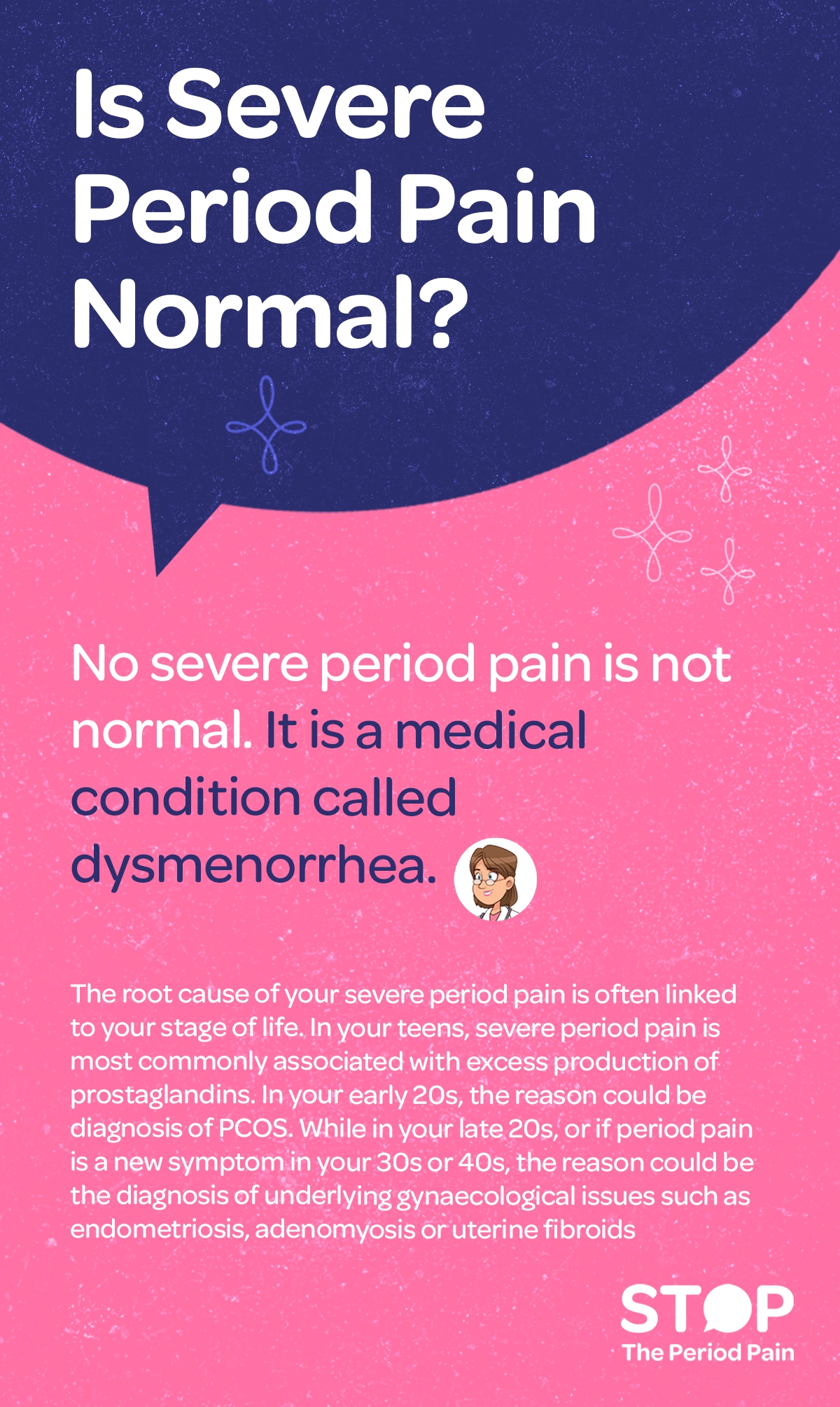
No, severe period pain is not normal. It is a medical condition called dysmenorrhea.
While some mild discomfort is a natural part of the menstrual cycle, period pain that stops you from going to school, college, or work is not normal. You must visit a gynaecologist immediately to find the root cause and the right solution.
Why is severe period pain not normal?
The root cause of your severe period pain is often linked to your stage of life, affecting when and how a diagnosis is made. Understanding these “why’s” helps you identify the problem early.
In your teens, severe period pain is because of the prostaglandin spike.
In teenagers, severe pain usually happens because of an excess production of prostaglandins. These are the main “villain” chemicals that tell your uterus to start cramping so it can shed its lining.
- The Period Pain Formula: More prostaglandins = Tighter uterine cramping = More period pain.
- The Solution: This sort of pain can be effectively controlled by gynaecologist-prescribed NSAIDs (Non-Steroidal Anti-Inflammatory Drugs) which block the production of these chemicals.
In your early 20s, severe period pain could be because of PCOS.
In your 20s, severe period pain is not normal because it could be a symptom of PCOS (Polycystic Ovary Syndrome). While PCOS is more associated with irregular periods, the hormonal imbalance can lead to a thicker uterine lining. When the body finally sheds this lining, the intensity of the cramps and the heavy flow can be significantly higher lending to severe period pain.
It is important to remember that PCOS doesn’t necessarily ‘start’ in your 20s; it can develop anytime after the onset of menstruation. However, the 20s are reported to be the most common age for a formal diagnosis.
In your late 20s, 30s or 40s, severe period pain could be a sign of Endometriosis, Adenomyosis or Uterine Fibroids.
If severe period pain is a new symptom reported in your 30s or 40s, it is likely a symptom of underlying structural conditions like Endometriosis, Adenomyosis, or Uterine Fibroids.
- In endometriosis the lining grows outside the uterus, causing intense inflammation.
- In adenomyosis the uterine lining grows into the muscle wall, making the uterus “bulky” and swollen.
- Uterine fibroids, are non-cancerous growths that can make the uterus contract more forcefully and cause heavy bleeding. Uterine fibroids are most commonly diagnosed between your 30s and 50s.