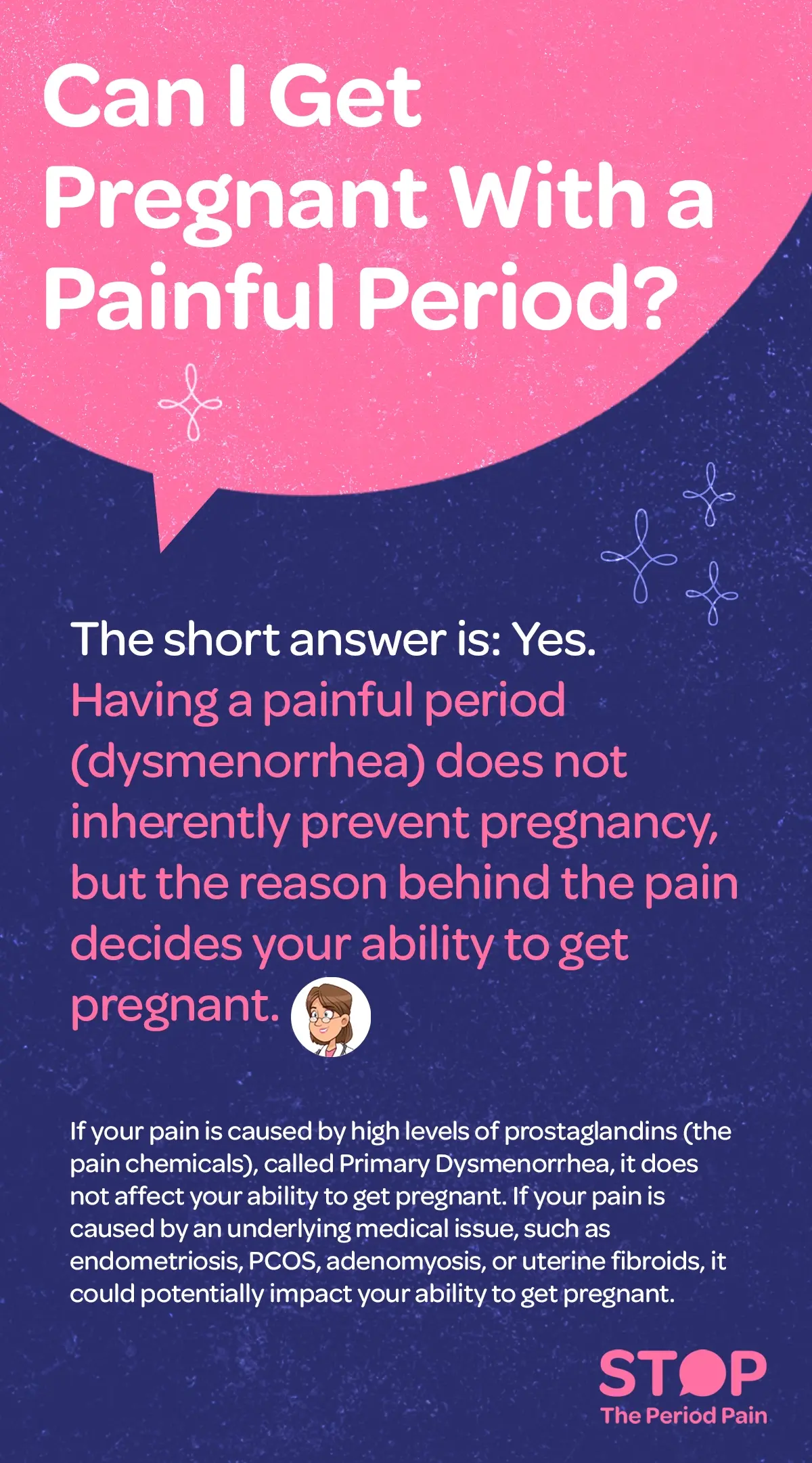
The short answer is: Yes. Having a painful period (dysmenorrhea) does not inherently prevent pregnancy, but the reason behind the pain matters.
There are two ways to look at this:
Primary Dysmenorrhea (Common Cramps)
If your pain is caused by high levels of prostaglandins (the pain chemicals), it is called Primary Dysmenorrhea. This is the most common type of period pain and does not affect your ability to get pregnant. It is simply a sign of excess production of prostaglandins i.e. a strong uterine response during your cycle.
Secondary Dysmenorrhea (Underlying Conditions)
If your pain is caused by an underlying medical issue, it could potentially impact fertility. In India, we see many cases where severe pain is a symptom of:
- Endometriosis: Where tissue similar to the lining of the uterus grows outside it. An estimated 4.2 crore women in India suffer from endometriosis.
- PCOS (Polycystic Ovary Syndrome): Which is highly prevalent in India and can cause irregular, painful cycles. 1 in 5 Indian girls are estimated to suffer from PCOS.
- Adenomyosis: Where uterine lining abnormally grows into the muscle wall of the uterus. An estimated 2.35 crore women in India suffer from adenomyosis.
- Uterine Fibroids: Non-cancerous growths that develop within or on the walls of the uterus. The prevalence of uterine fibroids is estimated to be 24% in urban areas, and 37.65% in rural areas.
Why does confusion exist in India?
In many households, there is a myth that “painful periods mean a healthy, fertile uterus” or, conversely, that “pain is a sign of weakness that prevents motherhood.” Neither is strictly true. Fertility is primarily about ovulation (the release of an egg), while period pain is about uterine contractions.
When should you be concerned about?
- If the pain is new or worsening: If you never had pain before and it starts in your late 20s or 30s.
- If the pain lasts longer than your period: Pain that starts days before or continues after bleeding stops.
- Pain during intimacy: This can often be a sign of conditions like endometriosis, which may require medical intervention if you are planning a family.
Watch this 1 minute video to understand when you should be concerned about period pain.