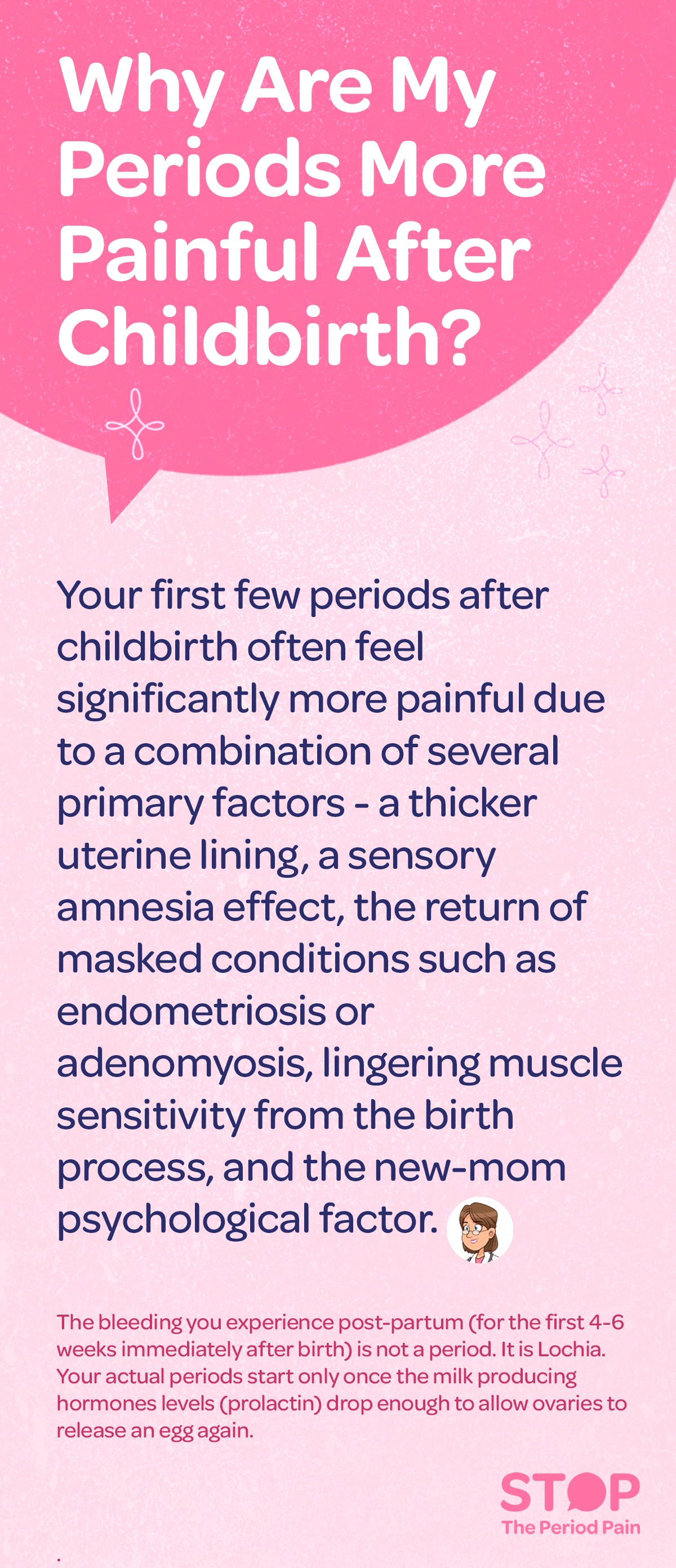
Your first few periods after childbirth often feel significantly more painful due to a combination of several primary factors: a thicker uterine lining, a sensory amnesia effect, the return of masked conditions, lingering muscle sensitivity from the birth process, and the new-mom psychological factor.
Thicker Endometrial Lining
Your first postpartum cycles often don’t release an egg. Without ovulation, your body is unable to regulate the uterine lining’s growth, which causes it to become very thick. To shed this extra-thick lining, your body releases a massive surge of prostaglandins (the villain pain chemicals), triggering more forceful and painful contractions.
Uterine Sensitivity
Your uterus has recently undergone massive physical stretching and shrinking (medically called involution). During early cycles, these recovering muscle fibers and pelvic nerves remain hypersensitive, making each contraction feel more sharp than your pre-pregnancy period-pain.
The Sensory Amnesia Effect
After going many months without a period, your brain’s pain memory resets. When your periods resume, you are no longer accustomed to period discomfort, which builds the perception that your periods have become more painful. It is like the first heatwave of summer; the temperature might be the same as last year, but because you haven’t felt it in months, it feels twice as intense.
The Return of Masked Conditions:
Pre-existing conditions like endometriosis, or adenomyosis typically go dormant during pregnancy. When your period returns, these conditions also reactivate. Because you haven’t felt this specific type of inflammatory pain for over a year, the return of the stabbing or dragging sensations can feel significantly more aggressive than before.
C-Section Adhesions
If you had a C-section, the healing process can, in some cases, create adhesions (bands of scar tissue). As the uterus contracts and moves during your period, these adhesions can pull on sensitive internal structures, causing sharp, localised pain.
The New-Mom Psychological Factor
Chronic sleep deprivation and the high-stress demands of caring for a newborn physically alter how your brain processes pain signals. Because your nervous system stays on high-alert, meaning a cramp that used to feel like a 4/10 can easily feel like an 8/10.
A Quick Clarification: Lochia vs. Periods
It’s important to remember that the bleeding you experience for the first 4–6 weeks immediately after birth is not a period. It is Lochia—the healing of the site where the placenta was attached. Your actual period only returns once your prolactin (the milk-producing hormone) levels drop enough to allow your ovaries to release an egg again.