The short answer is yes, absolutely. Dysmenorrhea is serious. But let’s be clear: serious does not mean life-threatening. It means life-disrupting.

What makes it even more serious is how easily it is brushed off by women, or how often they are told to just deal with it.

We need to look at dysmenorrhea (period pain) through the lens of regular healthcare:

  • When you have a toothache, you immediately see a dentist.
  • When you have a sprain or a fracture, you get an X-ray and wear a bandage.
  • When you have a migraine, you take medication and rest in a dark room.

In any of these cases, no one tells you to just brave it out and pretend nothing is wrong. If we take these everyday pains seriously, then why do we ignore dysmenorrhea (period pain)?

Why We Never Ignore Chest Pain (And Why Your Period Pain is No Different)

Think about chest pain. When someone experiences sudden, sharp chest pain, it is taken with the utmost seriousness. Why? Because everyone knows it isn’t just an isolated pain—it is a loud warning signal for an underlying problem, like heart blockages.

Dysmenorrhea works the exact same way. Severe period pain could also not be just an isolated cramp; it could be the body’s warning signal for serious, hidden medical conditions like Endometriosis, Adenomyosis, PCOS (PMOS), Uterine Fibroids.

Just like you wouldn’t ignore chest pain and hope a heart issue goes away on its own, you cannot ignore dysmenorrhea. It could be a clinical medical symptom. If period pain is disrupting your normal life every single month, it is serious enough to see a gynaecologist.

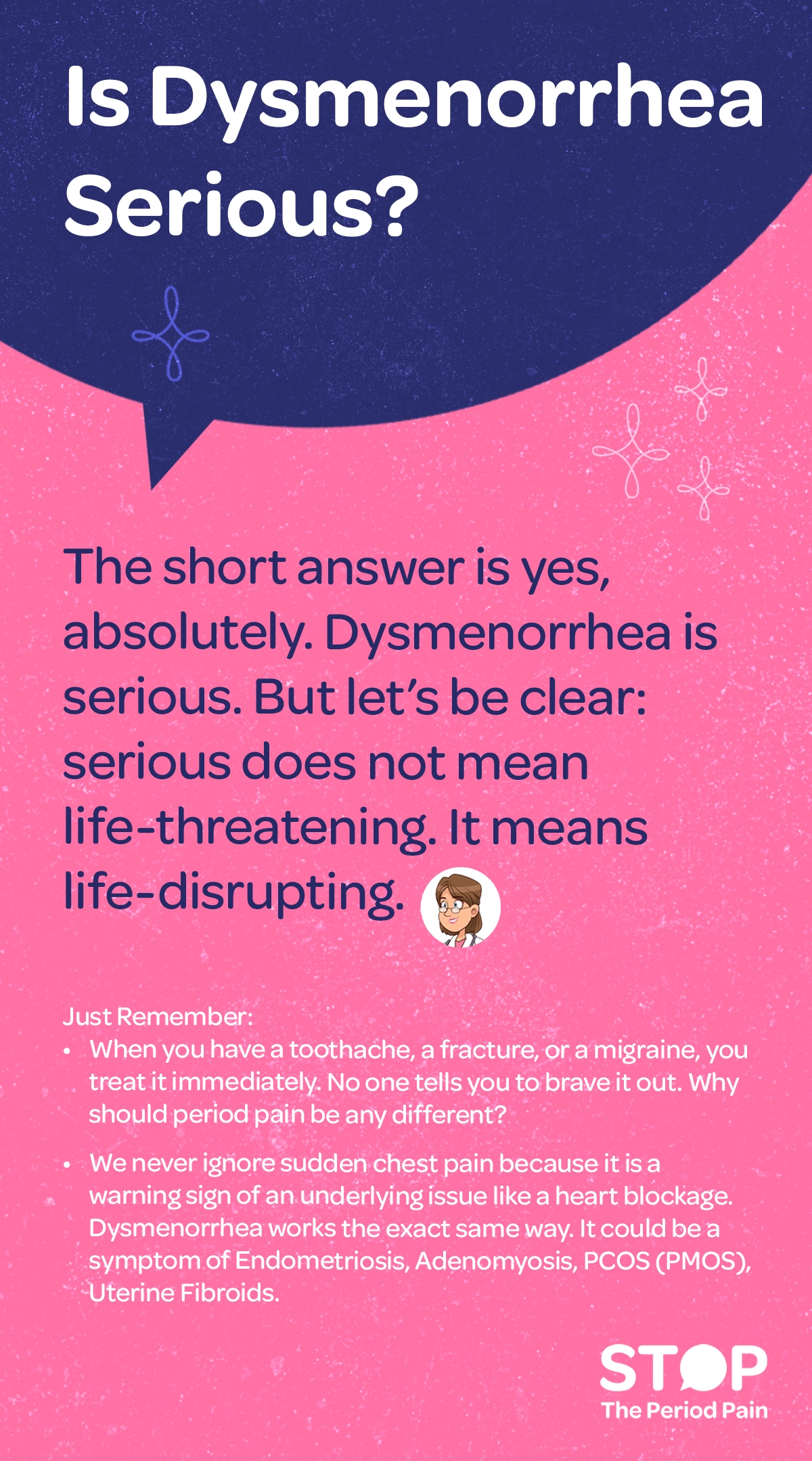
Infographic titled "Is Dysmenorrhea Serious?" featuring educational text about menstrual pain. The main heading asks, "Is Dysmenorrhea Serious?" followed by the statement: "The short answer is yes, absolutely. Dysmenorrhea is serious. But serious does not mean life-threatening—it means life-disrupting." A section labeled "Just Remember:" compares period pain to conditions such as a toothache, fracture, or migraine, explaining that these are treated immediately rather than endured, and asks why period pain should be treated differently. The infographic further compares dysmenorrhea to sudden chest pain, stating that both can serve as warning signs of an underlying medical condition. It concludes by noting that dysmenorrhea may be a symptom of endometriosis, adenomyosis, PCOS (also referred to as PMOS in some regions), or uterine fibroids, encouraging readers to recognize severe period pain as a condition that deserves medical attention rather than being dismissed as normal.

Your Journey to #StopThePeriodPain Starts Here

Every month, millions of Indian girls & women suffer in silence, told that their severe period pain (dysmenorrhea) is “normal.” Our mission is to break that silence. #StopThePeriodPain campaign is here to empower you with 3 simple truths:

Period Pain Calculator Section

Hit Up Our Period Pain Calculator

For real, how bad is your pain? Our interactive tool uses a 1-10 pain scale and a few quick questions to help you get the full picture. In just a few clicks, you’ll know if your pain is a chill or a major red flag.

Don’t Take Period Pain Lightly.

Period pain (dysmenorrhea) is a real medical issue.
Visit a gynaecologist and #StopThePeriodPain

Don't take period pain lightly