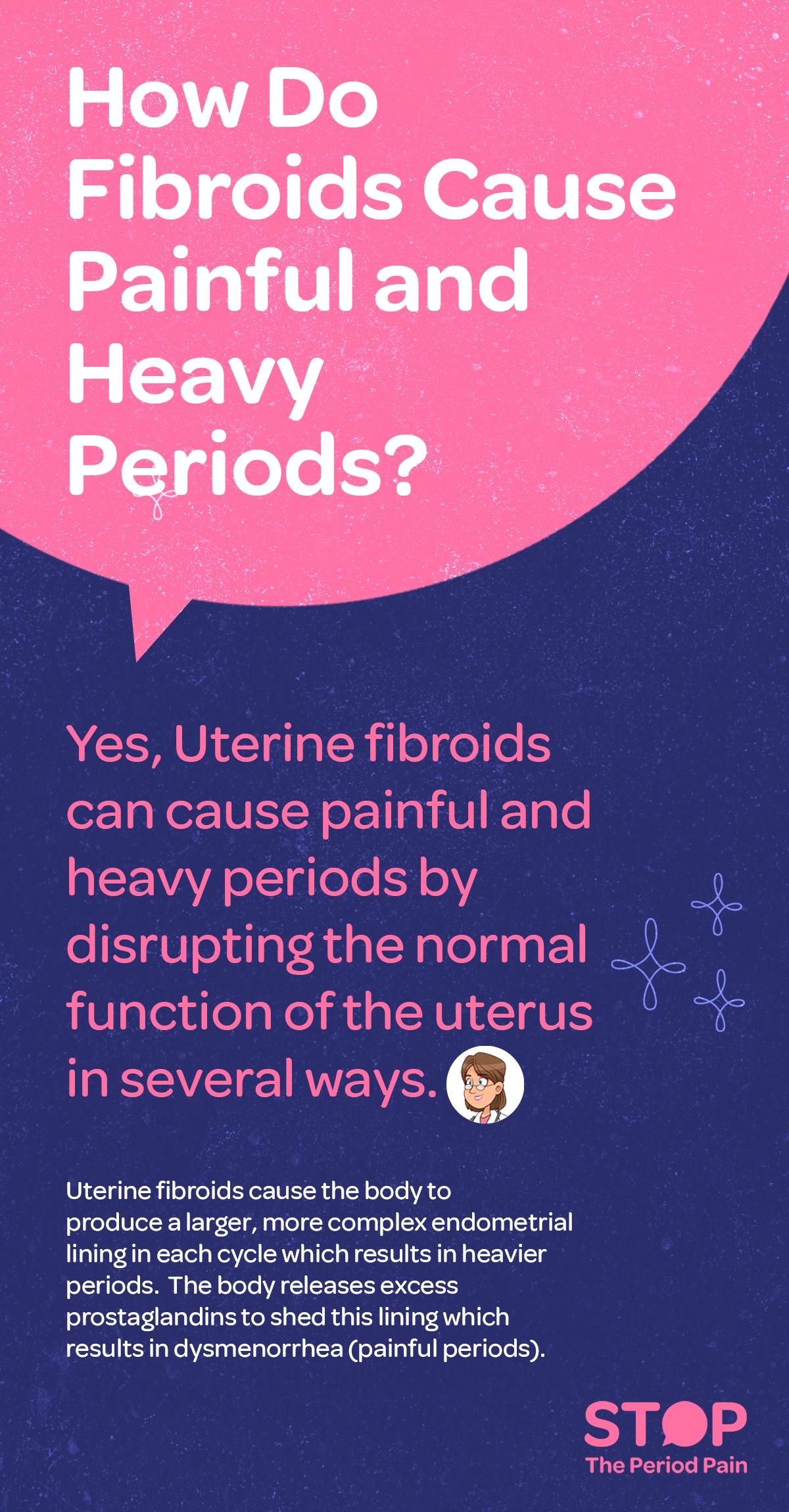
Yes, Uterine fibroids can cause painful and heavy periods by disrupting the normal function of the uterus in several ways.

Uterine fibroids cause the body to produce a larger, more complex endometrial lining each cycle, which in turn leads to significantly heavier menstrual bleeding (menorrhagia). To expel this larger lining, the uterus must contract more forcefully. The body releases a higher amount of prostaglandins leading to more intense contractions and causing severe menstrual pain (dysmenorrhea). As uterine fibroids grow, the increased blood flow and slower expulsion can lead to the formation of large blood clots, which can be painful to pass.

Prevalence of Uterine Fibroids in India is estimated at 37.65% in rural populations and 24% in the urban populations.

A graphic with a dark blue background and a large pink speech bubble at the top. The speech bubble contains the question in bold white text: "How do fibroids cause painful and heavy periods?" Below the speech bubble, in pink text, it reads: "Yes, uterine fibroids can cause painful and heavy periods by disrupting the normal function of the uterus in several ways." Below this, in smaller white text, it explains that uterine fibroids cause the body to produce a larger, more complex endometrial lining each cycle, leading to heavier menstrual bleeding. It also states the body releases excess prostaglandins to shed this lining, causing dysmenorrhea (painful periods).The graphic ends with the campaign message "STOP The Period Pain." Which is a knowledge initiative campaign by Blue Cross Laboratories the makers of meftal spas.

Your Journey to #StopThePeriodPain Starts Here

Every month, millions of Indian girls & women suffer in silence, told that their severe period pain (dysmenorrhea) is “normal.” Our mission is to break that silence. #StopThePeriodPain campaign is here to empower you with 3 simple truths:
Period Pain Calculator Section

Hit Up Our Period Pain Calculator

For real, how bad is your pain? Our interactive tool uses a 1-10 pain scale and a few quick questions to help you get the full picture. In just a few clicks, you’ll know if your pain is a chill or a major red flag.