Meera, a 30-year-old working professional in Hyderabad, knew the monthly agony well. Her period pain was debilitating — the kind that brought her life to a standstill for two full days every month. If those days fell on a weekend, she felt lucky to have not missed work. If they fell mid-week, the embarrassment of constantly asking for sick leave was crushing. Thankfully, the work-from-home policy reduced the embarrassment, but the pain remained.
Like many, Meera avoided the gynaecologist, partly due to her fear of doctors, and largely because her mother always told her that such intense period pain was “normal and just part of being a girl.” This cultural reassurance helped Meera avoid the clinic… until she started Googling.
One day, she typed “sharp period pain” into the search bar. The results that came up were alarming: mentions of Endometriosis. She was stressed and worried, but still didn’t visit a doctor.
Like Meera, millions of girls and women spend their time stressed and worried about their intense period pain being endometriosis, largely because most information online is generic and leaves you with more questions than answers.
That’s why this blog is different. As a campaign against period pain, we are here to ensure that we eliminate every trace of myth and mystery from your mind regarding period pain. This blog is for you, and by the end of it, you will be confident in your understanding the differences between endometriosis and dysmenorrhea, and ready to take the right next step.
In This Story
The Relationship between Dysmenorrhea and Endometriosis
Let’s start with a crucial relationship: Dysmenorrhea (Period Pain) is a common symptom of Endometriosis.
What does a symptom mean?
Think of it like a fever. When you have a fever, it is not the actual disease; it is your body’s way of sending an alarm. The fever itself could be caused by:
- A minor, temporary issue, like the Common Cold. (You manage it with rest and medicine, and it goes away.)
- An underlying, major problem, like a severe Urinary Tract Infection (UTI). (This requires specific medical investigation and targeted treatment.)
Similarly, period pain is a symptom that acts as an alarm bell. Since around 80% of Indian girls and women suffer from dysmenorrhea, you absolutely do not need to panic that your period pain means you have Endometriosis. Here is the critical distinction you need to remember: All Endometriosis cases cause period pain, but not all period pain is caused by Endometriosis.
This crucial distinction is important to remember because the period pain experienced in Endometriosis (called Secondary Dysmenorrhea) is very different from the common pain experienced without it (called Primary Dysmenorrhea).
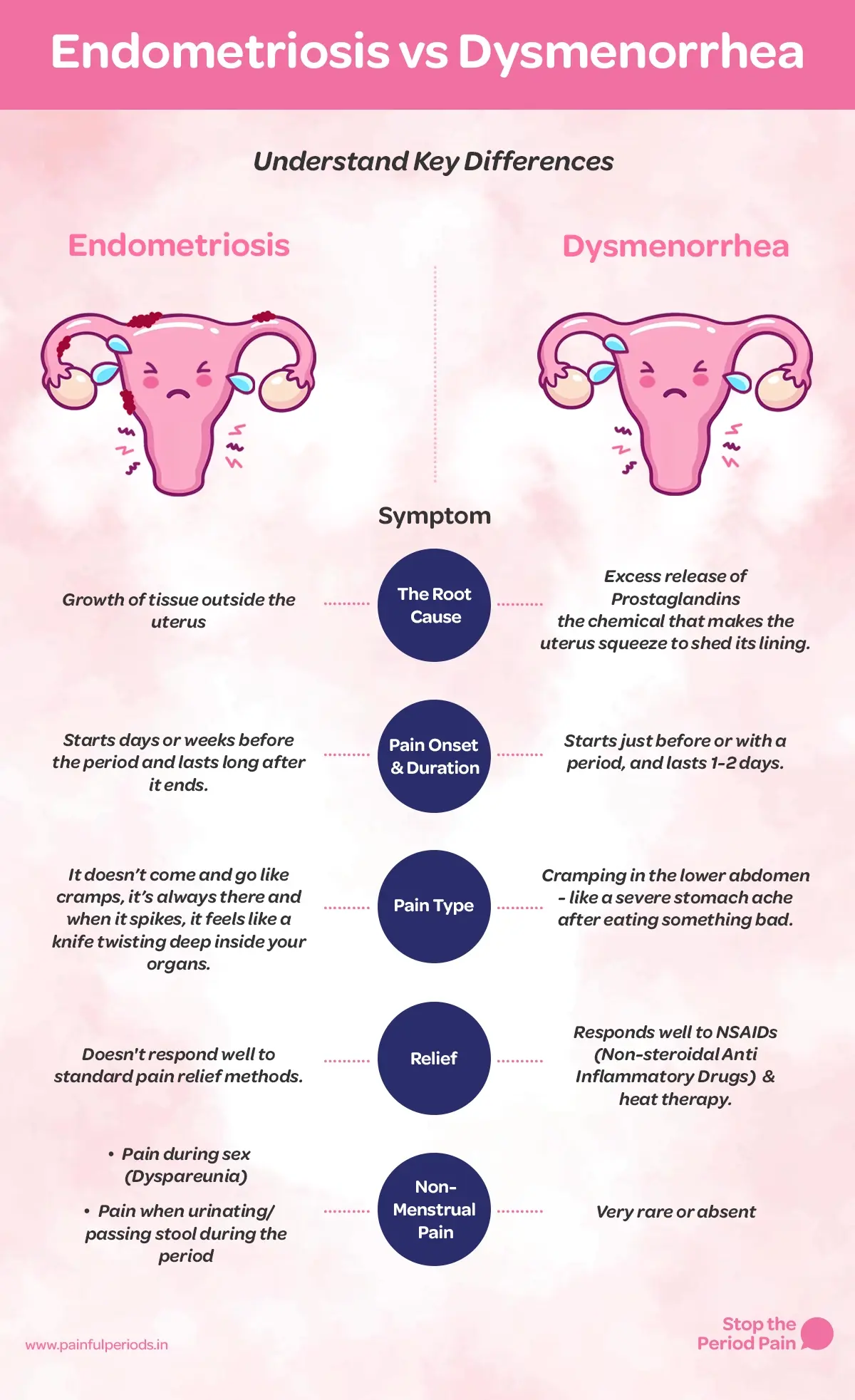
Endometriosis vs Dysmenorrhea - Key Differences
To give you the clarity you need, we have put together a very simple comparison below, and explained with simple to understand examples. By the end of this Endometriosis vs. Dysmenorrhea breakdown, you will be very clear about the differences between the two.
Pain Onset & Duration
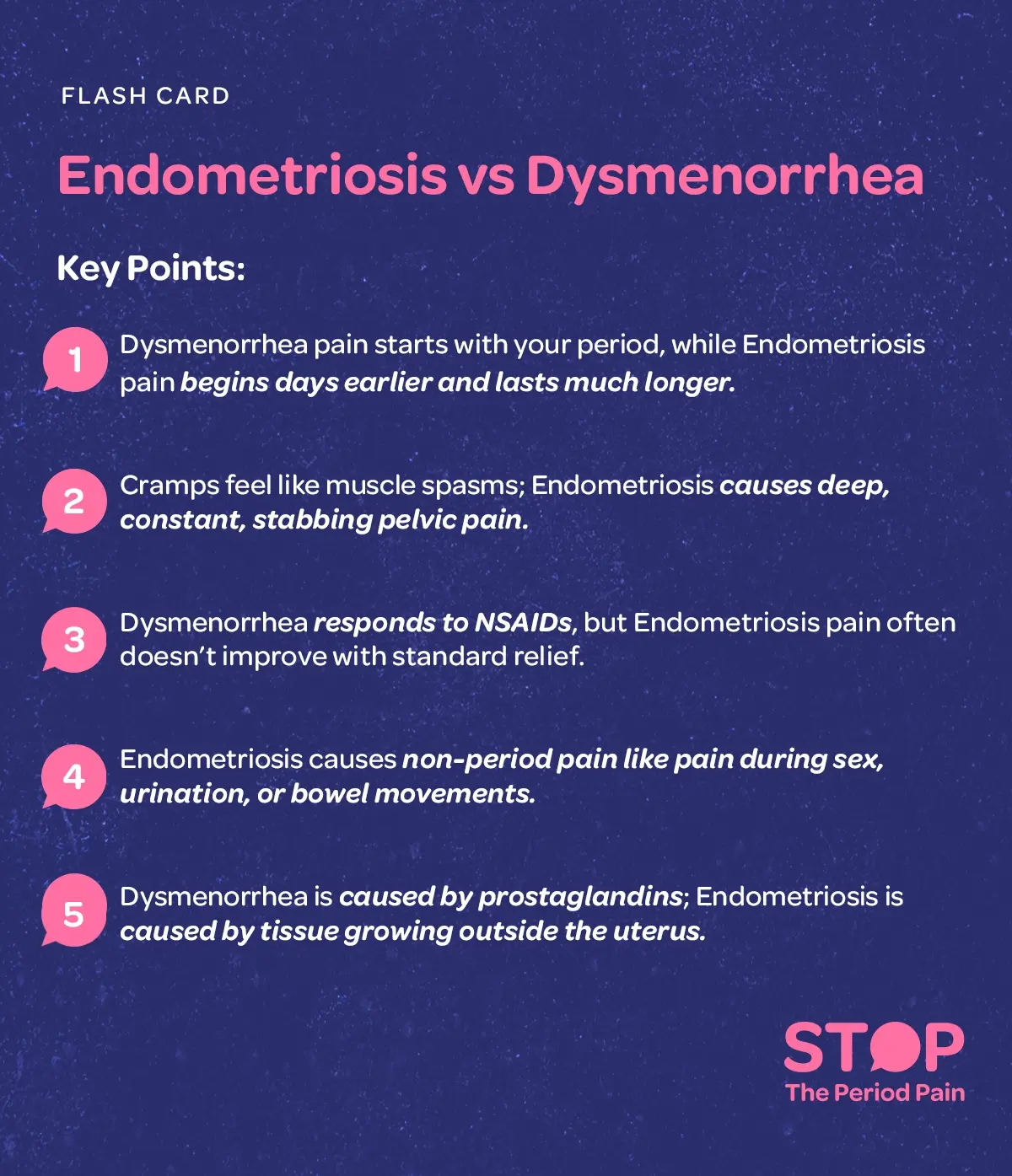
- In Dysmenorrhea (The common period cramps), the pain usually starts just before or with your period and lasts for only 1 to 2 days. The pain eases up as the heavy bleeding subsides. Let’s understand this with an example: Let’s say your cramps hit Monday morning with your period, but by Wednesday morning, you feel almost normal. In cases of very severe pain, this might extend to a Thursday, but it will definitely ease up.
- In Endometriosis, the pain is much more persistent. It often starts days or even a week before your period begins and can last long after the bleeding stops. Picture this: You feel stabbing pain five days before your expected flow, and the discomfort and pain continue for days after the bleeding has finished.
Pain Type, Intensity & Relief
This is where the difference between the two conditions becomes undeniable.
- In Dysmenorrhea (The common period cramps), the pain is caused by the uterus squeezing to shed its lining. It feels like a bad, intense muscle spasm. The period pain is like a severe stomach ache after eating something bad — it’s agonising for a few hours, or 1 to 2 days. While it can certainly be painful and make you uncomfortable, it is generally manageable with gynaecologist recommended NSAIDs (Non-Steroidal Anti Inflammatory Drugs), a hot water bag, or rest.
- In Endometriosis, the pain that starts very early and lasts much after your period is caused by trapped blood, inflammation, and scarring of tissue outside the uterus. This causes a deep, persistent, and chronic type of pain. Period pain in Endometriosis feels like a constant, heavy internal stone pressing down on your pelvis and lower back. It doesn’t come and go like a cramp; it’s always there, and when it spikes, it feels like a knife twisting deep inside when you move, cough or go to the washroom. Critically, this pain often radiates down your legs, making them feel heavy or numb. Endometriosis period pain often does not respond well to standard medication like NSAIDs (Non-Steroidal Anti Inflammatory Drugs).
Non-Menstrual Pain (The Biggest Possible Red Flag For Endometriosis)
This is the key point that certainly separates a normal period from endometriosis period pain.
- In Endometriosis, you experience recurring pain even when you’re not on your period, which can manifest as deep pain during sex (Dyspareunia), chronic lower back ache, or severe, sharp pain when passing urine or stool during your menstrual window. This kind of all-month discomfort is never normal.
- In dysmenorrhea, it is extremely rare to have such issues of non-menstrual pain.
The Root Cause
- In Dysmenorrhea (Common Period Cramps), the pain is caused by the uterus naturally releasing excessive amounts of a chemical called Prostaglandins. These chemicals tell the uterine muscle to squeeze intensely to shed its lining. The pain is purely a muscle contraction.
- In Endometriosis , the cause is the growth of tissue—similar to the tissue that lines the inside of the uterus — outside the uterus. This misplaced tissue also responds to hormones by bleeding during your period. But since the blood is trapped, it causes chronic inflammation, irritation, and scarring inside your pelvis. The pain is not just a muscle contraction; it’s internal bleeding and scarring.
Gynaecologist’s Advise:
Now you clearly know the critical differences between Dysmenorrhea and Endometriosis. While neither should be ignored—because both significantly impact your quality of life, productivity, and mental health— Endometriosis pain must, in fact, be taken very seriously. Why? Because the chronic inflammation and scarring caused by this disease can progressively damage your reproductive organs, and eventually, it can even impact your ability to conceive and maintain fertility.
Hit Up Our Period Pain Calculator
For real, how bad is your pain? Our interactive tool uses a 1-10 pain scale and a few quick questions to help you get the full picture. In just a few clicks, you’ll know if your pain is a chill or a major red flag.

The Moral of the Story
For generations, we have been told that pain is normal and part of a woman’s fate resulting in a crippling delay in the diagnosis of Endometriosis.
It is estimated that 4.2 crore women in India suffer from Endometriosis, and the diagnosis takes, on average, 8 to 11 years. The biggest reason for this delay is the ignorance of period pain—treating it as normal—and a persistent fear of visiting a gynaecologist. This wait is not just inconvenient; it allows the disease to progress.
Do not take period pain lightly. It is a real medical issue. Visit a gynaecologist and #StopThePeriodPain
Your Journey to #StopThePeriodPain Starts Here
Every month, millions of Indian girls & women suffer in silence, told that their severe period pain (dysmenorrhea) is “normal.” Our mission is to break that silence. #StopThePeriodPain campaign is here to empower you with 3 simple truths:
More Stories To Read
Transform your understanding of period pain through engaging and informative stories based on real medical insights.
The Answers You've Been Looking For
Get clear, concise answers to your most pressing questions about period pain.
- Can Menstrual Pain Cause Depression?
- What is the cause of period pain?
- What are the symptoms of period pain?
- Why is my period so clotty and painful?
- What do large blood clots during period mean?
- When to see a doctor for painful periods?
- What will a gynaecologist do for painful periods?
- Can dysmenorrhea cause depression?
- What is the best treatment for period pain?
- How do you relieve period pain in teens?
Disclaimer:
This content is for informational purposes only and is not a substitute for professional medical advice. The information provided here is based on general trends and may not apply to every individual, as every woman’s body and experience with period pain is unique.
Do not self-diagnose or self-treat. If you are experiencing painful periods, especially if the pain is moderate to severe or accompanied by other concerning symptoms, you must consult with a gynaecologist. Ignoring severe period pain can lead to a significant delay in diagnosing underlying conditions that require proper medical attention. Always prioritise a confident conversation with your gynaecologist over self-treatment.