More Answer For You
- Are Painful Periods a Sign of Good Fertility?
- Does a heavier period mean more fertile?
- When to see a doctor for painful periods?
- What will a gynaecologist do for painful periods?
- Why is my period so clotty and painful?
- What are the symptoms of period pain?
- Why does my period pain go down to my thighs?
- Can dysmenorrhea cause depression?
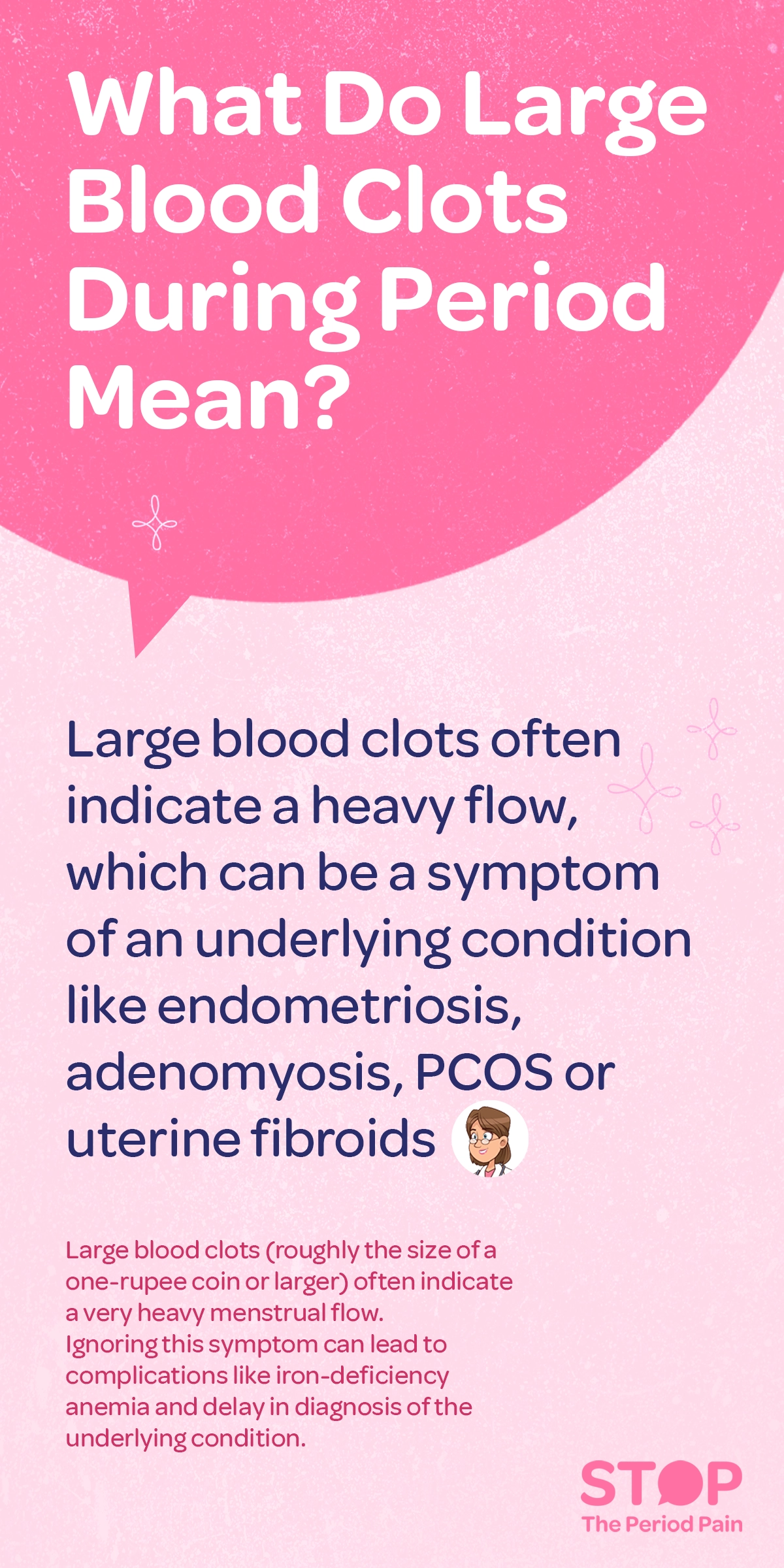
Small blood clots during a period are normal, but large blood clots can be a red flag for an underlying medical condition.
Large blood clots (roughly the size of a one-rupee coin or larger) often indicate a very heavy menstrual flow. While this can sometimes be due to hormonal imbalances, it can also be a symptom of a gynaecological condition such as:
- Endometriosis: A condition where tissue similar to the uterine lining grows outside the uterus, causing severe pain and heavy bleeding.
- Adenomyosis: A condition where the uterine lining grows into the muscle wall of the uterus, leading to an enlarged uterus, heavy bleeding, and painful cramping.
- PCOS (Polycystic Ovary Syndrome): A hormonal disorder that can lead to irregular and heavy periods.
- Uterine Fibroids: Non-cancerous growths in the uterus that can cause heavy bleeding, large blood clots, and pelvic pain.
If you are passing large blood clots regularly, you should visit a gynaecologist. Ignoring this symptom can lead to complications like iron-deficiency anemia and can delay the diagnosis of a treatable or manageable condition.
More Answer For You
- Are Painful Periods a Sign of Good Fertility?
- Does a heavier period mean more fertile?
- When to see a doctor for painful periods?
- What will a gynaecologist do for painful periods?
- Why is my period so clotty and painful?
- What are the symptoms of period pain?
- Why does my period pain go down to my thighs?
- Can dysmenorrhea cause depression?
Hit Up Our Period Pain Calculator
For real, how bad is your pain? Our interactive tool uses a 1-10 pain scale and a few quick questions to help you get the full picture. In just a few clicks, you’ll know if your pain is a chill or a major red flag.
References:
- International Journal of Reproduction, Contraception, Obstetrics and Gynecology – Prevalence of dysmenorrhoea and its effect on quality of life among nursing students
- Prevalence And Management Of Dysmenorrhea Among The Adolescents Of Selected Schools Of Rehan, Distt Kangra
- A Study of School Absenteeism During Menstruation Amongst Adolescent Schoolgirls in An Urban Area of North India
- Times of India – Why ‘Period pain is normal’ might be the biggest myth in women’s health
- Health Radius – Top 5 menstrual problems women shouldn’t ignore
- Financial Express – Period pain may not always be routine