Think back to the last time you had a bad headache that kept coming back. Your family probably got worried, checked if you had a fever, and took you to an eye specialist to get your sight tested. But when you’re doubled over with period pain every month, the response is usually just to ‘bear it’ or simply ‘adjust.’ Why is a headache, or any other pain, treated like a medical priority while your period pain is not taken seriously?
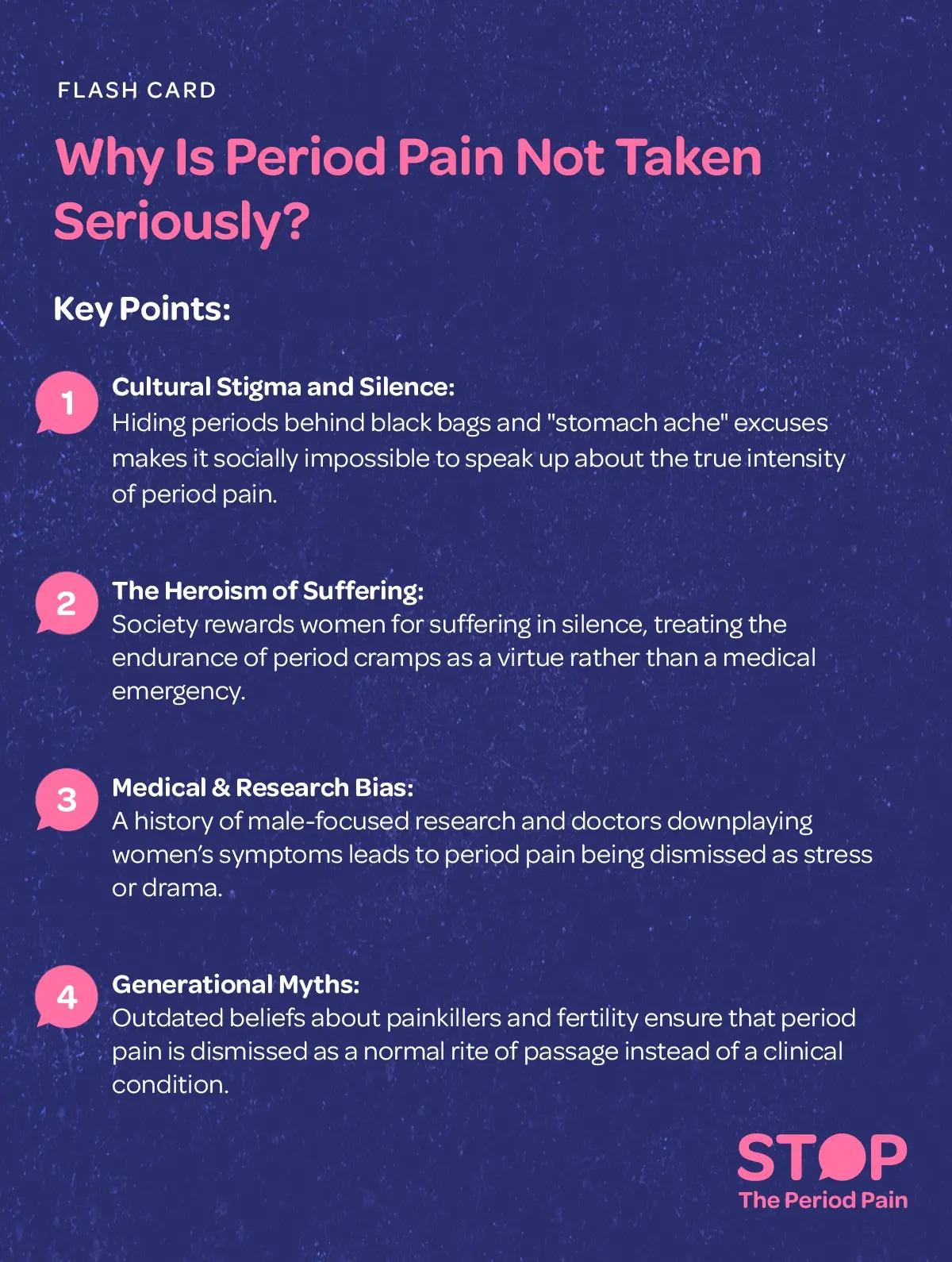
The reasons are complex—spanning societal, generational, and medical barriers. As experts campaigning against dysmenorrhea, we have compiled the key factors uncovered through our research and interactions.
In This Story
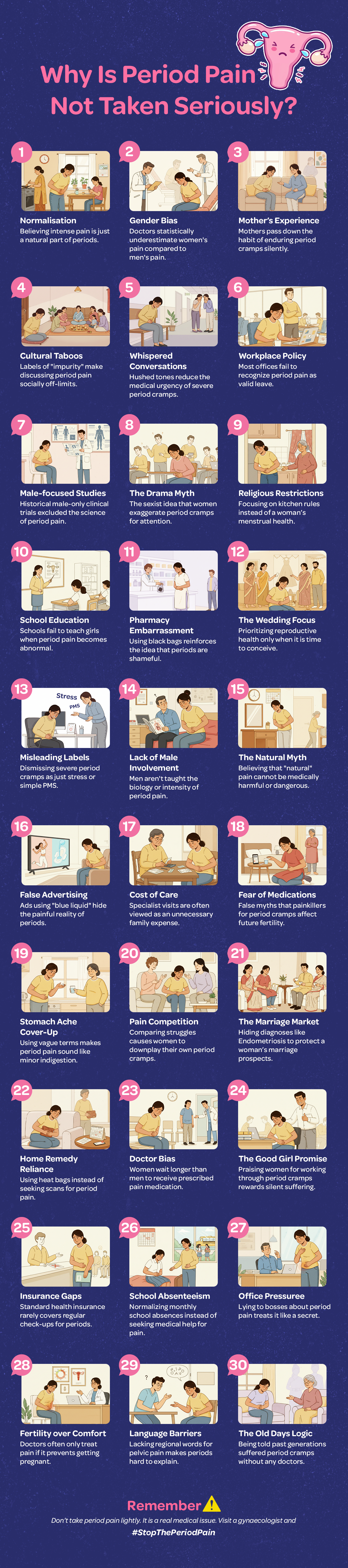
30 Reasons Why Period Pain Isn’t Taken Seriously
- Normalisation: The belief that pain is just part of the period process.
- Gender Bias: Medical studies show that doctors often underestimate a woman’s pain compared to a man’s.
- Mother’s Experience: Mothers telling daughters, “I went through it, so can you.”
- Cultural Taboos: When periods are labeled as impure, discussing period pain becomes off-limits.
- Whispered Conversations: Discussing period pain in hushed tones reduces its perceived urgency and seriousness.
- Lack of Workplace Policy: Most offices don’t recognise period pain as a valid reason for sick leave.
- Male-focussed Studies: For decades, clinical trials for painkillers only used male subjects, which means period pain was left out of the science entirely.
- Drama Myth: The false idea that women exaggerate period pain for attention.
- Religious Restrictions: Not being allowed in kitchens or religious spaces shifts the focus of periods to rules rather than health.
- Poor School Education: Girls are never taught about period pain in school, so they grow up without the right lessons on what is normal and what is a medical issue.
Hit Up Our Period Pain Calculator
For real, how bad is your pain? Our interactive tool uses a 1-10 pain scale and a few quick questions to help you get the full picture. In just a few clicks, you’ll know if your pain is a chill or a major red flag.

- Pharmacy Embarrassment: Buying pads in black plastic bags or wrapping them in newspaper reinforces the idea that periods are a secret—and that period pain should be, too.
- The Wedding Focus: Reproductive health is often only prioritised when it’s time to conceive.
- Misleading Labels: Severe period pain is often written off as just stress or PMS instead of being treated as a real medical issue.
- Lack of Male Involvement: Most Indian men are never taught the biology of periods, so they cannot understand the intensity of period pain.
- The Natural Myth: The belief that because period pain is natural, it cannot be harmful, prevents people from seeking medical help.
- False Advertising: Sanitary pad ads show ‘blue liquid’ and happy dancing, hiding the reality of periods and period pain.
- Cost of Specialist Care: Visiting a gynaecologist is often seen as an extra expense.
- Fear of Medications: Mothers often fear that taking painkillers for period pain will affect future fertility, but this is a myth that leaves daughters suffering needlessly.
- Stomach Ache Cover-Up: In most Indian homes, we use the vague term stomach ache to hide that we a girl is on her periods, which makes people treat period cramps like a minor digestive issue rather than real pain.
- Period Pain Competition: Women often tell themselves their period cramps are ‘not that bad’ compared to what others face, which causes them to downplay and ignore serious period pain.
Period Pain Lessons For Parents
Shocking Scale of India’s Period Pain
- The Marriage Market: The fear that a diagnosis like Endometriosis or PCOS will affect a woman’s value or marriage prospects, leading people to hide the reality of their periods and ignore severe period cramps.
- Over-reliance on Home Remedies: Relying only on ajwain water or heat bags instead of seeking a medical scan treats period pain like a temporary discomfort, ignoring the fact that it could be a sign of an underlying condition.
- Doctor Bias: Doctors often take longer to prescribe painkillers to women than to men.
- The Good Girl Promise: Being the girl who carries on despite her period cramps is seen as a virtue, which rewards women for hiding their period pain instead of seeking help.
- No Health Insurance Coverage: Most standard health insurance plans don’t cover regular check-ups for periods, making it harder for women to afford the professional help they need for severe period cramps.
- School Absentism: Parents think it is okay for a girl to miss school every month because of her period pain, treating the absence as normal rather than seeking medical help for her period cramps.
- Office Pressure: Feeling like you can’t tell your boss the real reason you need a day off forces you to blame something else for your period pain, making you treat it like a shameful secret instead of a legitimate health concern.
- Focus on Fertility over Comfort: Doctors often only treat period pain if it interferes with getting pregnant.
- Language Barriers: In many Indian languages, there is no specific word for chronic pelvic pain, forcing women to describe their periods using vague terms like stomach pain that fail to capture the severity of their period cramps.
- The Old Days Logic: Being told that previous generations managed period pain without complaining or needing doctors.
Gynaecologist’s Advise:
Medical science is clear: pain that interferes with your daily life is a clinical symptom, not a normal part of being a woman. When severe period cramps are dismissed as common discomfort, underlying conditions like Endometriosis, Adenomyosis, or Fibroids go undiagnosed for years.
My advice: Don’t take period pain lightly. It is a real medical issue.
- Track your symptoms: Note if your pain requires you to miss school, work, or social events.
- Visit a gynaecologist: Openly discuss all your symptoms with the gynaecologist. They will help you get relief from period pain.
The Moral of the Story
The 30 reasons period pain isn’t taken seriously are rooted in history, culture, and silence—but they don’t have to define your future. We must stop romanticising the “strength” it takes to suffer through period cramps and start prioritising the health of those who experience them.
Your Journey to #StopThePeriodPain Starts Here
Every month, millions of Indian girls & women suffer in silence, told that their severe period pain (dysmenorrhea) is “normal.” Our mission is to break that silence. #StopThePeriodPain campaign is here to empower you with 3 simple truths:
More Stories To Read
Transform your understanding of period pain through engaging and informative stories based on real medical insights.
The Answers You've Been Looking For
Get clear, concise answers to your most pressing questions about period pain.
- What are The Types of Prostaglandins and Their Functions?
- How To Stop Period Pain Forever?
- When to see a doctor for painful periods?
- What To Do When You Have Period Pains?
- What Do Cramps On Your Period Mean?
- What are prostaglandins and their functions?
- How to reduce prostaglandins?
- What are NSAID medicines?
- What is the best treatment for period pain?
- Why do period cramps hurt so bad the first day?
References:
- National Library of Medicine: Medical student perceptions of gender and pain: a systematic review of the literature
- UCL: Analysis: Women’s pain is routinely underestimated, and gender stereotypes are to blame
- National Library of Medicine: “Just” a painful period: A philosophical perspective review of the dismissal of menstrual pain
- National Geographic: Period pain has long been ignored. That’s changing
- National Library of Medicine: Female Gender Scheme is Disturbed by Polycystic Ovary Syndrome: A Qualitative Study From Iran
- National Library of Medicine: Polycystic ovary syndrome and its impact on women’s quality of life: More than just an endocrine disorder
- Kings College London: Study finds women less likely to be prescribed pain relief than men
- National Library of Medicine: A Literature Review on Pain Management in Women During Medical Procedures: Gaps, Challenges, and Recommendations
- PNAS: Sex bias in pain management decisions
- Springer Nature Link: Seeing Menstruation in the Media: The News, Advertisements, and Memes That Teenagers Encounter via Social Media and the Mainstream Media
Disclaimer:
This content is for informational purposes only and is not a substitute for professional medical advice. The information provided here is based on general trends and may not apply to every individual, as every woman’s body and experience with period pain is unique.
Do not self-diagnose or self-treat. If you are experiencing painful periods, especially if the pain is moderate to severe or accompanied by other concerning symptoms, you must consult with a gynaecologist. Ignoring severe period pain can lead to a significant delay in diagnosing underlying conditions that require proper medical attention. Always prioritise a confident conversation with your gynaecologist over self-treatment.