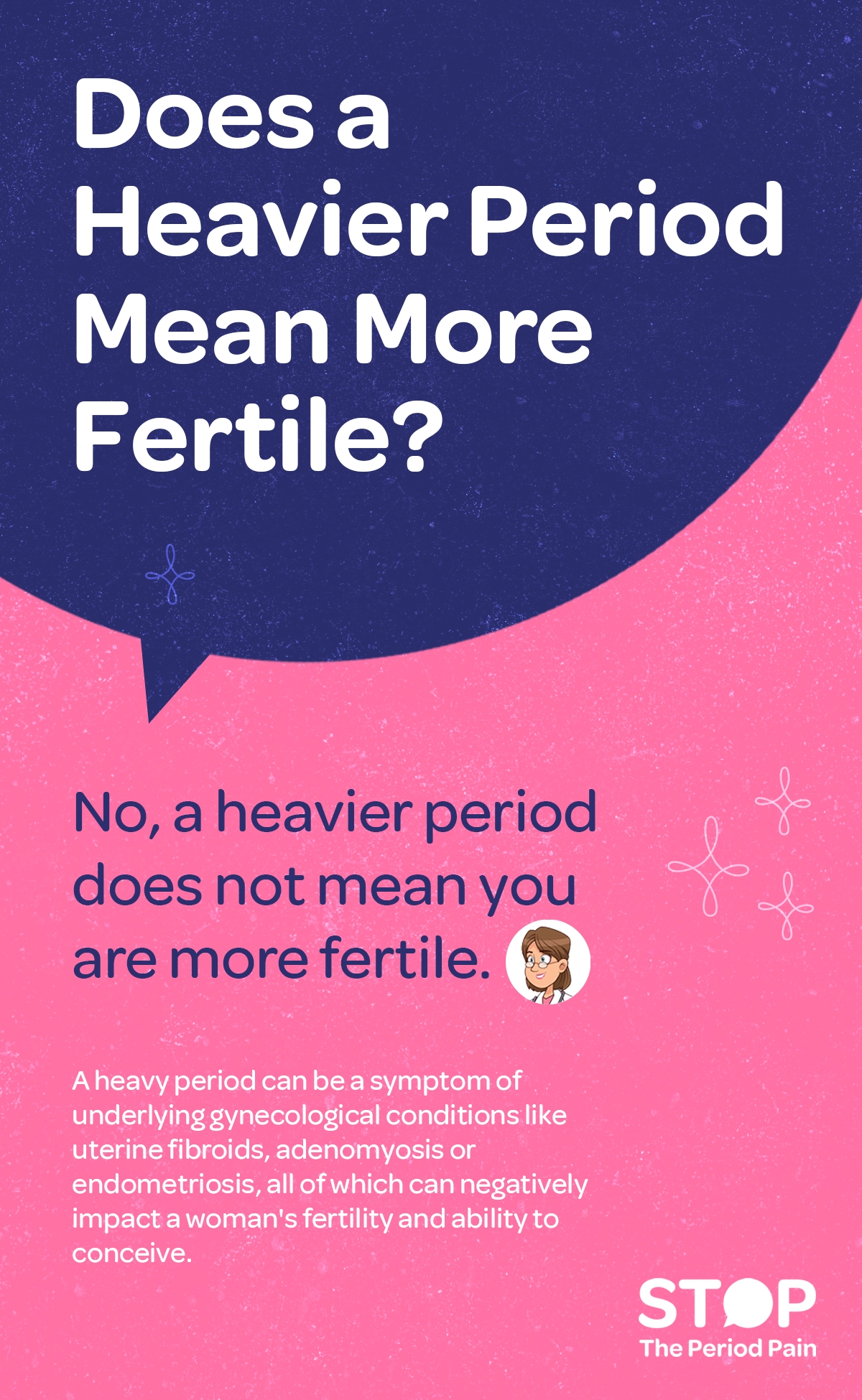
No, a heavier period does not mean you are more fertile.

It is a common misconception that a heavy period indicates a healthy uterine lining ready for pregnancy. A heavy menstrual period (menorrhagia) is not a sign of a healthy or more fertile reproductive system. In fact, it can be a symptom of underlying gynecological conditions like uterine fibroids, adenomyosis or endometriosis, all of which can negatively impact a woman’s fertility and ability to conceive.

Ignoring heavy periods can lead to complications such as anemia and can delay the diagnosis of a treatable or a manageable condition.

An infographic with a pink and dark blue background addressing the misconception about heavy periods and female fertility. At the top, in large bold white text inside a dark blue speech bubble, it says, "Does a Heavier Period Mean More Fertile?" Below that, on a pink background, the text reads, "No, a heavier period does not mean you are more fertile." There is a small cartoon illustration of a female doctor next to this text. Further down, smaller white text explains: "A heavy period can be a symptom of underlying gynecological conditions like uterine fibroids, adenomyosis, or endometriosis, all of which can negatively impact a woman’s fertility problems and ability to conceive." In the bottom right corner, the campaign branding says, "STOP The Period Pain." The background also includes subtle star-like sparkles as decorative elements. The graphic ends with the campaign message "STOP The Period Pain." Which is a knowledge initiative campaign by Blue Cross Laboratories the makers of meftal spas.

Your Journey to #StopThePeriodPain Starts Here

Every month, millions of Indian girls & women suffer in silence, told that their severe period pain (dysmenorrhea) is “normal.” Our mission is to break that silence. #StopThePeriodPain campaign is here to empower you with 3 simple truths:
Period Pain Calculator Section

Hit Up Our Period Pain Calculator

For real, how bad is your pain? Our interactive tool uses a 1-10 pain scale and a few quick questions to help you get the full picture. In just a few clicks, you’ll know if your pain is a chill or a major red flag.