More Answer For You
- What are The Types of Prostaglandins and Their Functions?
- Why Is Period Pain Not Normal?
- Can Low Prostaglandin Levels Still Cause Period Pain?
- Why Are Prostaglandins Higher During Periods?
- Can Age Change Prostaglandin Levels In Periods?
- How to reduce prostaglandins?
- What are the warning signs that my period pain needs medical treatment?
- Can Painful Periods Cause Pain While Bowel Movement?
- Can Painful Periods Cause Pain While Urinating?
- Endometriosis vs Dysmenorrhea: Is Your Pain More Than Just a Cramp?
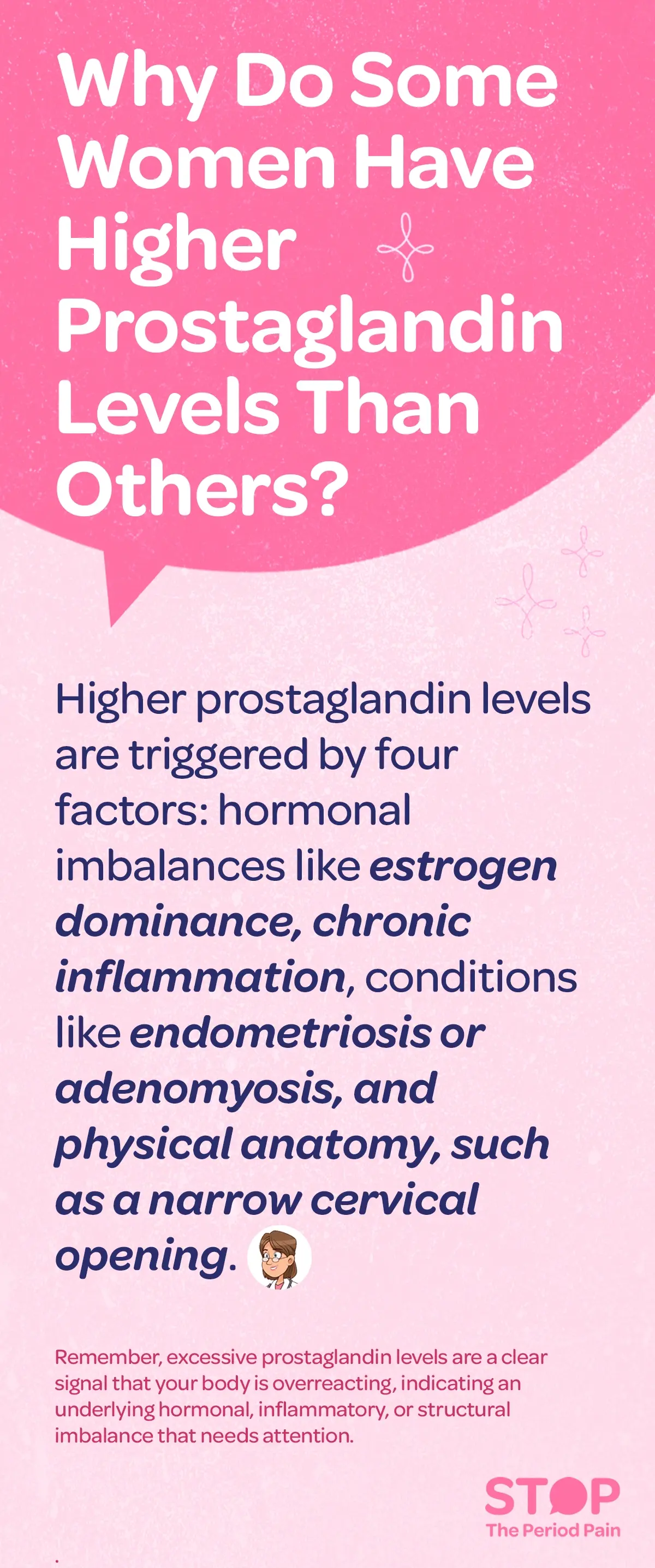
Higher prostaglandin levels in women are triggered by four biological factors: hormonal imbalances (such as estrogen dominance), chronic inflammation, and conditions like endometriosis or adenomyosis. In some cases, physical anatomy, such as a narrow cervical opening, also forces a higher production of prostaglandins.
Hormonal Imbalance (Estrogen Dominance)
Estrogen is the hormone responsible for building the uterine lining. If your estrogen levels are high, it can stimulate the lining to grow thicker. A thicker lining produces a higher concentration of prostaglandins, leading to more intense period cramps.
Chronic Inflammation
Prostaglandins essentially create inflammation in the body. If your body is already in a state of chronic inflammation—often caused by high stress, poor sleep, or dietary triggers—the uterus may overproduce prostaglandins.
Medical Conditions Like Endometriosis or Adenomyosis
In cases of endometriosis, uterine-like tissue grows outside the uterus, while in adenomyosis, it grows into the muscular wall of the uterus. These misplaced tissues produce their own prostaglandins independent of the uterine lining, resulting in a double dose of the chemical.
Physical Anatomy
A narrow cervical opening requires the uterus to contract more forcefully to shed the lining. To achieve these stronger contractions, the body produces higher levels of prostaglandins.
Excessive prostaglandin levels are a clear signal that your body is overreacting, indicating an underlying hormonal, inflammatory, or structural imbalance that needs attention.
More Answer For You
- What are The Types of Prostaglandins and Their Functions?
- Why Is Period Pain Not Normal?
- Can Low Prostaglandin Levels Still Cause Period Pain?
- Why Are Prostaglandins Higher During Periods?
- Can Age Change Prostaglandin Levels In Periods?
- How to reduce prostaglandins?
- What are the warning signs that my period pain needs medical treatment?
- Can Painful Periods Cause Pain While Bowel Movement?
- Can Painful Periods Cause Pain While Urinating?
- Endometriosis vs Dysmenorrhea: Is Your Pain More Than Just a Cramp?
Hit Up Our Period Pain Calculator
For real, how bad is your pain? Our interactive tool uses a 1-10 pain scale and a few quick questions to help you get the full picture. In just a few clicks, you’ll know if your pain is a chill or a major red flag.
References:
- PubMed Central: Estrogen-directed synthesis of specific prostaglandins in uterus
- MDPI: Inflammatory Markers in Dysmenorrhea and Therapeutic Options
- PubMed Central: Endometriosis and Adenomyosis: From Pathogenesis to Follow-Up
- PubMed Central: Uterine cervical stenosis: from classification to advances in management. Overcoming the obstacles to access the uterine cavity
- MSD Manual: Cervical Stenosis