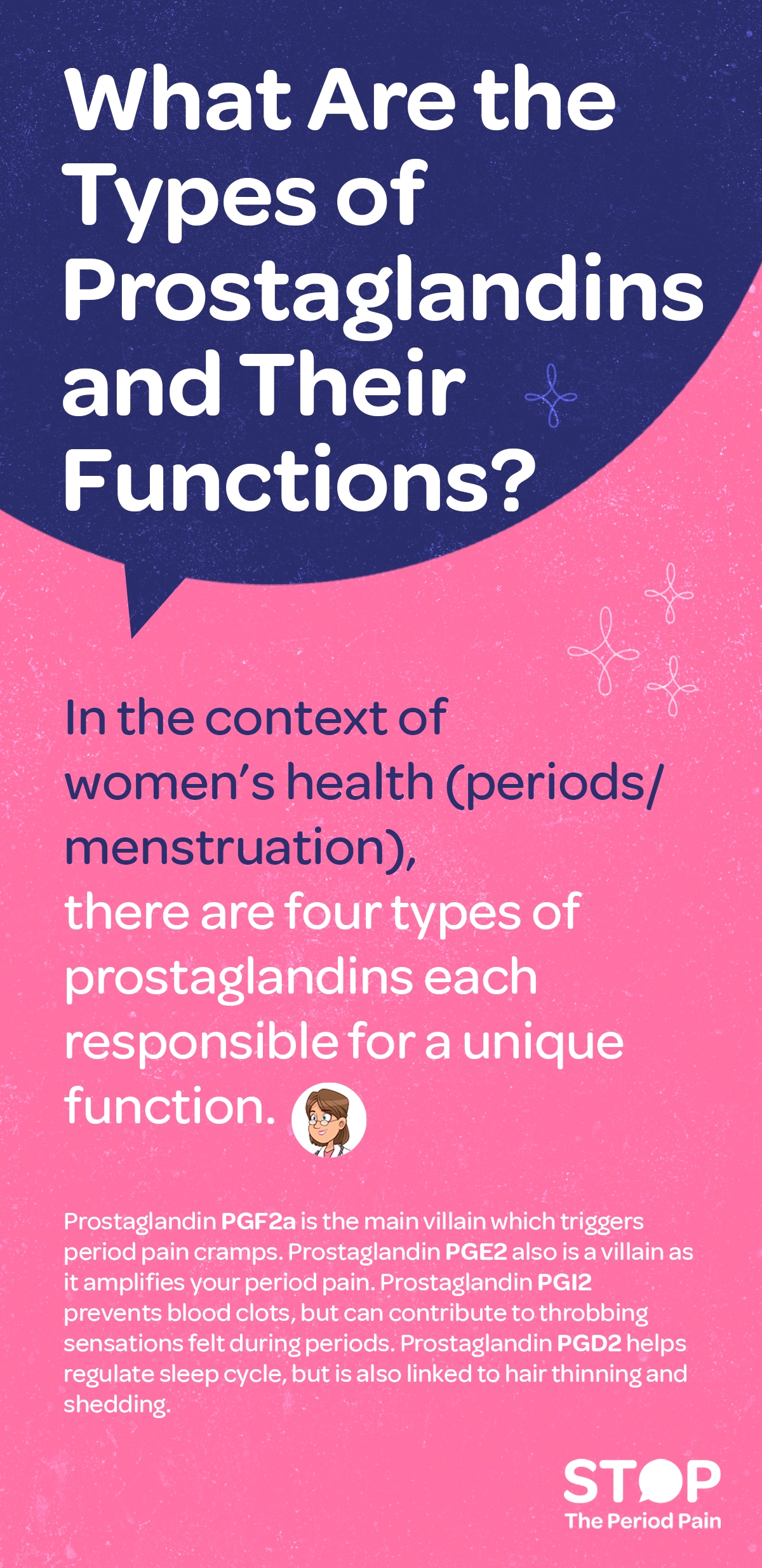
In the context of women’s health (periods/ menstruation), there are four types of prostaglandins each responsible for a unique function.

The four types of prostaglandins that are related to periods/ menstruation are:

Prostaglandin PGF2ɑ (F2 Alpha) - This triggers period cramping

This is the primary villain when it comes to period pain.

  • Role: It causes the uterine muscles to contract to shed the lining, causing periods.
  • The Problem: In many women in India suffering from severe cramps, the body produces too much PGF2ɑ. This leads to the intense, painful period spasms and even the period flu (the flu-like symptoms you experience during periods)).

Prostaglandin PGE2 - This amplifies period pain

This is the secondary villain when it comes to period pain. Think of this one as the volume knob on your period pain.

  • Role: It is involved in inflammation and fever.
  • The Problem: It makes your nerve endings extra sensitive. When PGE2 is high, even a normal contraction feels sharp and unbearable. PGE2 this contributes to the heaviness and swelling in the pelvic area.

Prostaglandin PGI2 - This regulates the blood flow

This prostaglandin has a slightly different job than the other types of prostaglandins.

  • Role: It helps prevent blood clots and helps blood vessels relax (known as vasodilation in medical terms).
  • The Problem: While it’s important for circulation, it can contribute to the “throbbing” sensation sometimes felt during inflammation.

Prostaglandin PGD2 - This regulates sleep and the scalp

  • Role: This type is found in the brain and the scalp.
  • The Connection: It is involved in regulating sleep cycles but high levels of PGD2 on the scalp are also linked to hair thinning and shedding.
Educational graphic titled ‘types of prostaglandins and their functions’ focused on women’s health, menstrual cycle, and period pain. The text explains that there are four main types of prostaglandins during menstruation, each with a different role in menstrual health. Prostaglandin PGF2α, described as the primary cause of menstrual cramps, period cramps, and dysmenorrhea, is identified as the main trigger of period pain. Prostaglandin PGE2 is noted to increase and amplify menstrual pain, uterine contractions, and inflammation during periods. Prostaglandin PGI2 is explained as preventing blood clots during menstruation, while also contributing to throbbing sensations and pulsing period pain. Prostaglandin PGD2 is described as helping regulate the sleep cycle, while also being linked to hair thinning, hair shedding, and hormonal changes in women. The graphic portraits the campaign message "STOP The Period Pain." Which is a knowledge initiative campaign by Blue Cross Laboratories the makers of meftal spas.

Your Journey to #StopThePeriodPain Starts Here

Every month, millions of Indian girls & women suffer in silence, told that their severe period pain (dysmenorrhea) is “normal.” Our mission is to break that silence. #StopThePeriodPain campaign is here to empower you with 3 simple truths:

Period Pain Calculator Section

Hit Up Our Period Pain Calculator

For real, how bad is your pain? Our interactive tool uses a 1-10 pain scale and a few quick questions to help you get the full picture. In just a few clicks, you’ll know if your pain is a chill or a major red flag.

Don’t Take Period Pain Lightly.

Period pain (dysmenorrhea) is a real medical issue.
Visit a gynaecologist and #StopThePeriodPain

Don't take period pain lightly