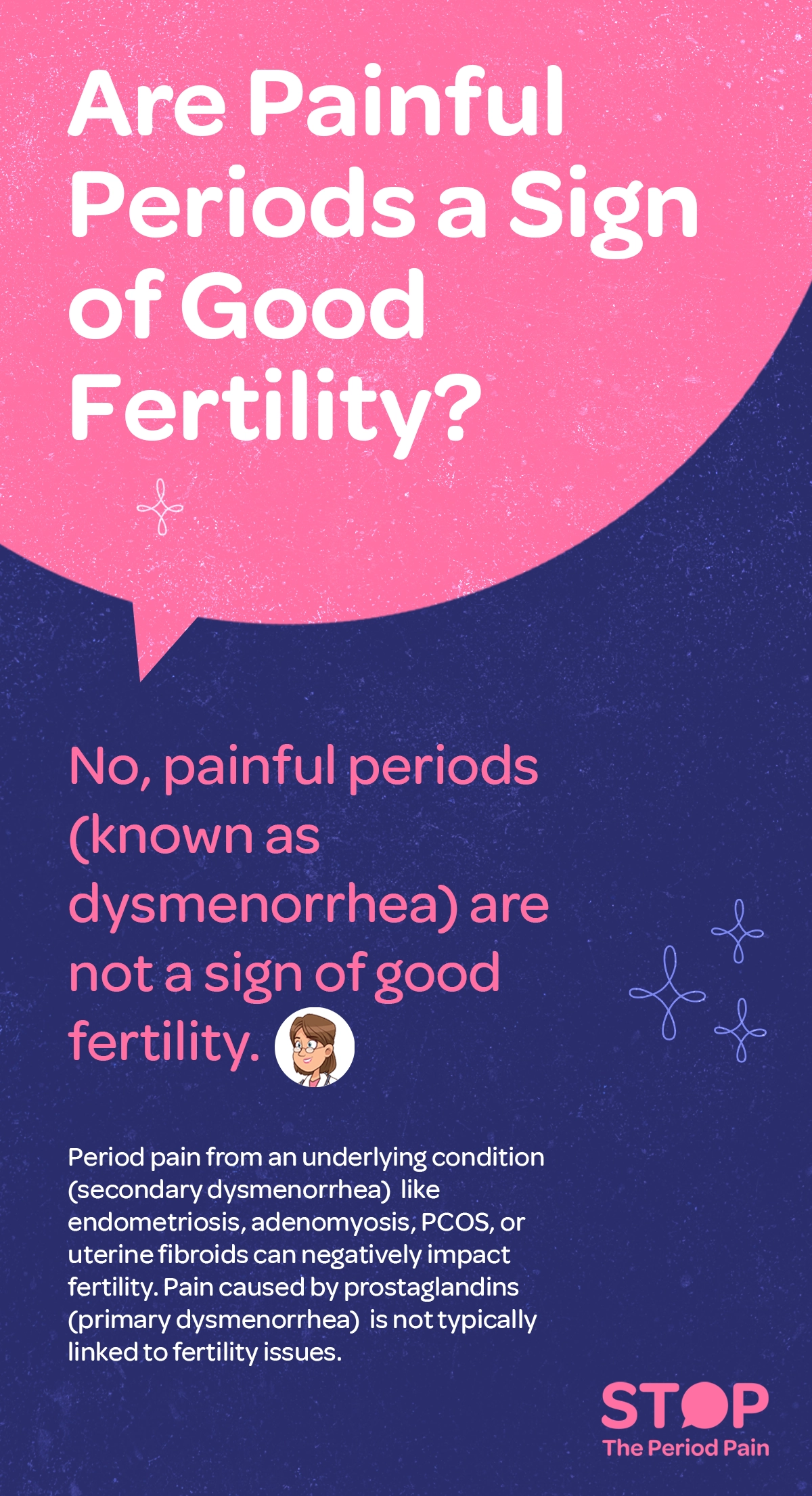
No, painful periods (known as dysmenorrhea) are not a sign of good fertility.

The link between period pain and fertility isn’t straightforward. If your pain is caused by the body’s overproduction of prostaglandins (known as primary dysmenorrhea), it is generally not linked to fertility issues. However, if your pain is caused by an underlying condition (known as secondary dysmenorrhea) like endometriosis, adenomyosis, PCOS, or uterine fibroids, these conditions can all negatively impact a woman’s fertility.

This distinction is especially important in India, where close to 80% of girls and women suffer from dysmenorrhea, and the pain is often dismissed as normal.

A graphic with a pink and navy background poses the question: “Are painful periods a sign of good fertility?” in large white and pink text. Below, the answer is given: “No, painful periods (known as dysmenorrhea) are not a sign of good female fertility,” with an illustration of a female doctor next to the text. The image explains that chronic period pain from underlying conditions like endometriosis, adenomyosis, PCOS, or uterine fibroids (types of secondary dysmenorrhea) can negatively affect reproductive health. It contrasts this with primary dysmenorrhea, caused by prostaglandins, which is not usually linked to infertility in women. Decorative star-like graphics are scattered throughout the navy background. The graphic ends with the campaign message "STOP The Period Pain." Which is a knowledge initiative campaign by Blue Cross Laboratories the makers of meftal spas.

Your Journey to #StopThePeriodPain Starts Here

Every month, millions of Indian girls & women suffer in silence, told that their severe period pain (dysmenorrhea) is “normal.” Our mission is to break that silence. #StopThePeriodPain campaign is here to empower you with 3 simple truths:
Period Pain Calculator Section

Hit Up Our Period Pain Calculator

For real, how bad is your pain? Our interactive tool uses a 1-10 pain scale and a few quick questions to help you get the full picture. In just a few clicks, you’ll know if your pain is a chill or a major red flag.