More Answer For You
- Why Are My Periods Getting More Painful in My 40s?
- Why Are Prostaglandins Higher During Periods?
- What are The Types of Prostaglandins and Their Functions?
- How Is Secondary Dysmenorrhea Treated?
- At What Age Do Period Cramps Get Worse?
- What are the warning signs that my period pain needs medical treatment?
- Why Do Some Girls Don't Get Period Cramps?
- Can Low Prostaglandin Levels Still Cause Period Pain?
- Why Is Period Pain Not Normal?
- How To Stop Period Pain Forever?
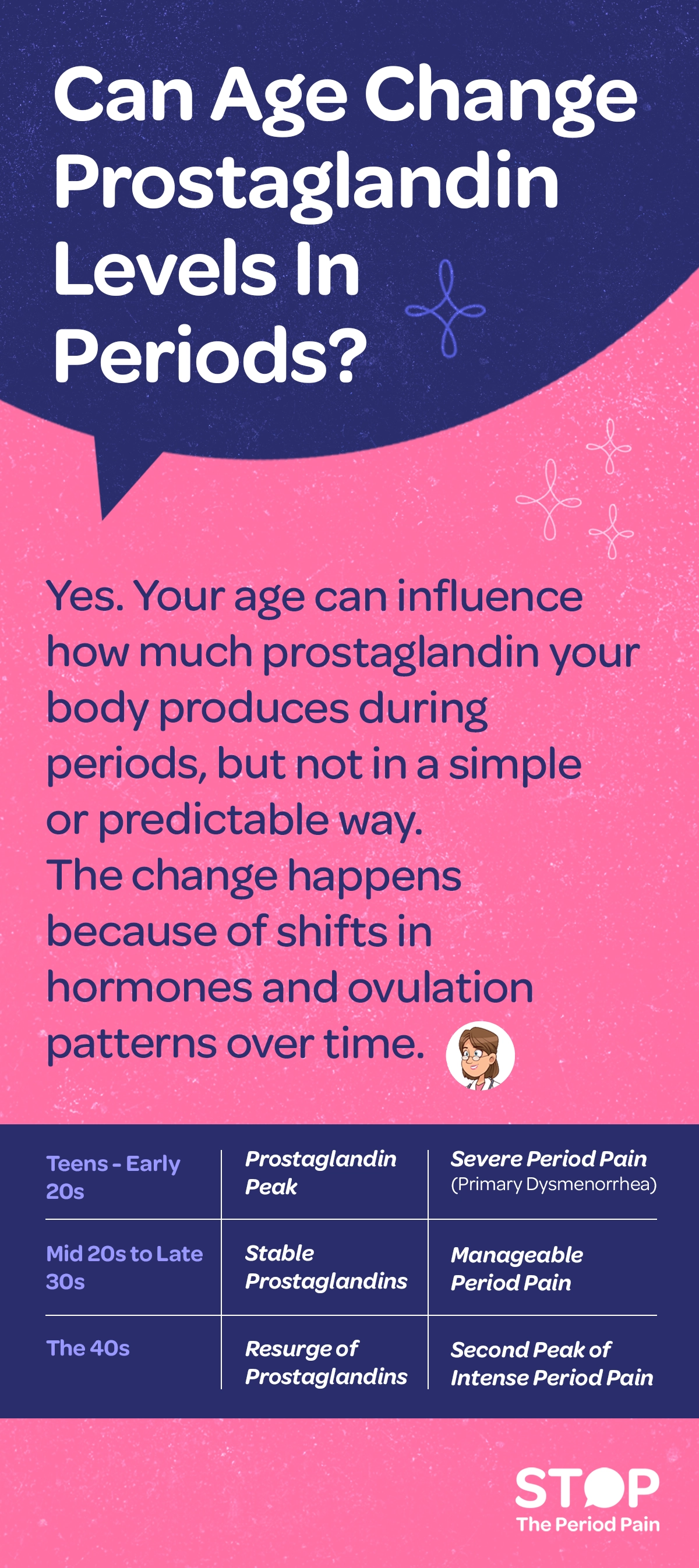
Yes. Age changes prostaglandin levels because your period evolves as your hormone levels shift through different life stages.
To understand this, we have to look at the interplay of three main elements:
- Estrogen: This is a female hormone responsible for building the uterine lining. Estrogen is most active during days 1–14 of a menstrual cycle.
- Progesterone: This female hormone protects what estrogen has built. Around the 14th day of a menstrual cycle, the ovaries release an egg (ovulation). When the egg is released, progesterone takes over to protect the uterine lining, ensuring the egg has everything it needs in case a pregnancy happens.
- Prostaglandins: If pregnancy doesn’t happen, progesterone levels drop and prostaglandins become active. They trigger your period to throw the unfertilised egg and the uterine lining out of the uterus, to make way for a fresh one in the next menstrual cycle.
Having understood this, now let’s look at how prostaglandins levels shift with age.
Teens to Early 20s: The Prostaglandin Peak
- The Hormones: The body is still perfecting its estrogen-progesterone cycle. Estrogen levels are often high, creating a thick uterine lining. However, ovulation can be irregular, meaning progesterone production is lower.
- The Result: A thick uterine lining leads to the release of massive amounts of prostaglandins triggering immense period pain. It is called Primary Dysmenorrhea and nearly 80% of girls in India suffer from it.
Mid 20s to Late 30s: Stable Prostaglandins
- The Hormones: For most women in India, this is the phase of peak hormonal balance. Estrogen and progesterone usually work in perfect sync, which allows prostaglandin levels to stabilise.
- The Result: Prostaglandin-driven period pain often decreases during these years. However, physical period pain (caused by conditions like Endometriosis, Adenomyosis, PCOS, or Uterine Fibroids) may begin to develop as these conditions progress over time. This type of period pain is called Secondary Dysmenorrhea.
The 40s: The Prostaglandin Resurge
- The Hormones: For most women in India, ages 40–46 mark the time of perimenopause (the transition toward menopause). During this time, estrogen often becomes dominant while progesterone drops significantly.
- The Result: High estrogen builds a much thicker uterine lining. A thicker lining contains more cells, and more cells mean a massive release of prostaglandins to shed that lining. This is why many women in their 40s experience a second peak of heavy, very painful periods.
| Age | Primary Hormone | Prostaglandin Level | Result |
|---|---|---|---|
| Teens – Early 20s | High Estrogen | Very High | Severe period pain/cramps (Primary dysmenorrhea) |
| Mid 20s to Late 30s | Balanced Estrogen & Progesterone | Stable | Manageable period pain |
| The 40s | Estrogen Dominant | High Resurge | A second peak of intense period pain |
Your Journey to #StopThePeriodPain Starts Here
Every month, millions of Indian girls & women suffer in silence, told that their severe period pain (dysmenorrhea) is “normal.” Our mission is to break that silence. #StopThePeriodPain campaign is here to empower you with 3 simple truths:
More Answer For You
- Why Are My Periods Getting More Painful in My 40s?
- Why Are Prostaglandins Higher During Periods?
- What are The Types of Prostaglandins and Their Functions?
- How Is Secondary Dysmenorrhea Treated?
- At What Age Do Period Cramps Get Worse?
- What are the warning signs that my period pain needs medical treatment?
- Why Do Some Girls Don’t Get Period Cramps?
- Can Low Prostaglandin Levels Still Cause Period Pain?
- Why Is Period Pain Not Normal?
- How To Stop Period Pain Forever?
Hit Up Our Period Pain Calculator
For real, how bad is your pain? Our interactive tool uses a 1-10 pain scale and a few quick questions to help you get the full picture. In just a few clicks, you’ll know if your pain is a chill or a major red flag.